

Sanctions, Soft War, and Sabotage: The Real Story Behind Iran’s Protests
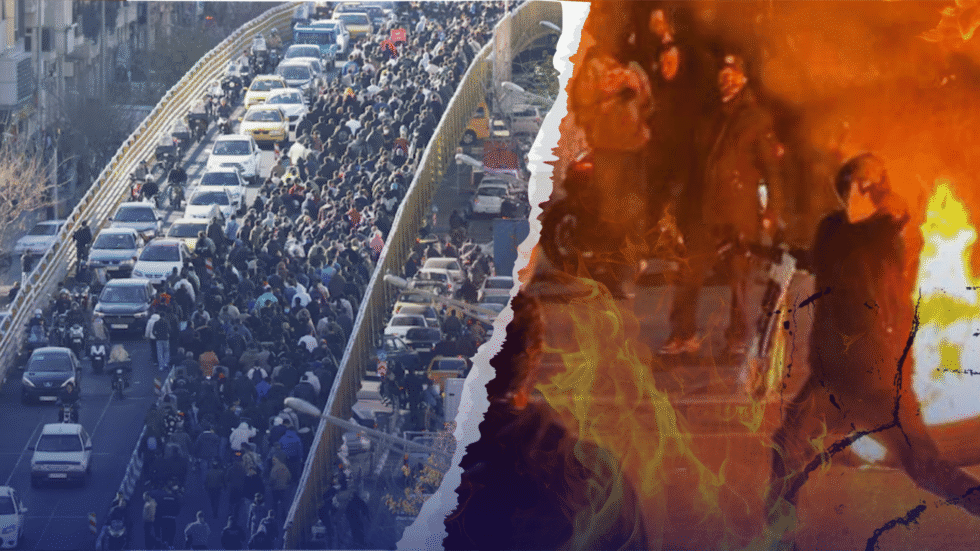
Shopkeepers first took to the streets of Iran over a collapsing currency and an economy suffocated by years of sanctions. Their demands were clear and rooted in lived reality: the ability to work, to trade, and to survive with dignity. The Iranian government acknowledged the demands of the people with Iranian President Pezeshkian asking his interior minister to meet with the representatives of the protesters to listen to their grievances. But within days, the character of the unrest began to change. Peaceful demonstrations were infiltrated, slogans shifted, violence erupted, and chaos replaced legitimate grievances. Western headlines, however, collapsed these distinctions, presenting riots and protest as one and the same. The Protests In the final days of 2025, a wave of peaceful demonstrations, first beginning in Tehran’s Grand Bazaar, took place throughout the country over economic grievances. The rial, Iran’s official currency, plunged to an unprecedented low. The rial’s collapse past 1,445,000 to the dollar was not accidental; in six months it lost nearly half its value, hitting dollar-dependent businesses hardest, according to The Cradle. Some suggested that the state deliberately allowed the rial to slide to ease its budget deficits, while others pointed to institutional corruption and a lack of cohesive economic policy. The Armed Riots Peaceful demonstrations began to shift as violence erupted and legitimate grievances descended into chaos. This transformation was not accidental but followed a familiar pattern in which economic pressure is weaponized and public frustration becomes an opportunity for exploitation. This is how genuine protest in Iran was hijacked, how foreign interests rapidly moved to capitalize on hardship, and how the “soft war” unfolded in real time against a nation that refused to submit. Iran’s Security Council released a report stating that 2,427 people, including innocent civilians and security personnel, were killed in what it described as a “full-scale atrocity” orchestrated by the United States and the Israeli regime. The statement further noted that an additional 690 individuals were killed during the riots, bringing the total death toll to 3,117. Among the dead were security officers, as well as a two-year-old girl who was shot by foreign-backed rioters. According to the report, intelligence services seized U.S.-made weapons and explosives smuggled into the country by rioters linked to foreign intelligence agencies. In addition, recent reports indicate that armed Kurdish separatist militias were dispatched from Iraq to join the unrest inside Iran. These militant elements reportedly carried out what were described as “Daesh-style crimes,” including beheadings, stabbings, and the destruction of mosques, bazaars, clinics, and other public infrastructure. Former CIA Director Mike Pompeo himself acknowledged that Mossad agents were present during the riots. The Israeli intelligence agency has also publicly expressed its support for the unrest through posts on social media. “We are with you,” the Mossad wrote in an official post on X days ago, including messages published in Farsi. In response, Iran temporarily cut internet access nationwide in an effort to disrupt the activities of riot leaders linked to foreign intelligence. According to Iranian Foreign Minister Abbas Aragchi, “The internet was only cut after we confronted terrorist operations and realized that orders were coming from outside the country. We have recorded voices of individuals giving orders from abroad to terrorist agents, instructing them to fire at police forces and fire at demonstrators if police forces were not present. Their intention was to spread killing.” In a subsequent speech, Ayatollah Ali Khamenei acknowledged the concerns of the initial protesters. He described the business community’s protest over the decline in the value of the national currency, and the resulting instability in the business environment, as a legitimate concern. “The businessperson is right in saying that under these conditions he cannot do business,” he said, adding that “the country’s officials acknowledge this, and I know that the honorable President and other senior officials are working to solve this problem.” However, he drew a clear distinction between protest and violence, stating that “a group of people who had been provoked and were the enemy’s mercenaries stood behind the business people and chanted slogans against Islam, Iran, and the Islamic Republic.” He emphasized that “protesting is legitimate, but it is different from rioting.” Propaganda as a Means to Legitimize War The United States has sought to weaken Iranian society through what Iranian officials and analysts describe as a “soft war,” a strategy aimed at eroding public confidence in the political system and exhausting societal resistance rather than relying solely on direct military confrontation. According to this framing, the origins of such tactics date back to the establishment of the Islamic Republic following the 1979 Islamic Revolution. The revolution ended U.S. influence over Iran by toppling the Western-aligned monarchy and halting what Iranian leaders characterize as Washington’s efforts to maintain control through a puppet regime. In the referendum that followed the revolution, reports clearly indicate that more than 98 percent of eligible voters participated, with nearly 99 percent voting in favor of establishing the Islamic Republic. This outcome, proponents argue, solidified long-term U.S. opposition toward Iran, rooted in the failure to prevent or reverse the revolution. The new political order emphasized Islam as the foundation of the constitution and rejected cooperation with tyrannical leadership. Supporters of the Islamic Republic describe this as a departure from governance models in some neighboring Arab states, which they argue accommodated Western influence. From this perspective, Iran’s emphasis on political independence and support for what it defines as oppressed populations has positioned it as a challenge to U.S. and Israeli interests in the region. Within this context, successive U.S. policies toward Iran, including support for Saddam Hussein during the Iran–Iraq War in the 1980s and later military interventions in neighboring Iraq and Afghanistan in the 2000s, are cited as part of a broader effort to contain or dismantle the Islamic Republic. Supporters of the Iranian political system argue that continued domestic backing is rooted in religious belief and a commitment to resisting perceived injustice and foreign domination. They point to public anger over the Shah’s alignment with Israel as one of the key catalysts of the 1979 revolution. According to this view, the primary tools employed by the United States and its allies have shifted toward non-military pressure, particularly economic sanctions, which are described as a central component of the “soft war” strategy. Proponents argue that Iran’s current economic challenges must be understood within this broader framework, viewing sanctions as an attempt to weaken public resolve and destabilize the political system. Some analysts aligned with this perspective suggest that efforts to exploit economic protests through violent unrest may have produced unintended consequences. They argue that many Iranians who initially protested over economic grievances later joined large demonstrations opposing the riots themselves and rejecting foreign involvement in Iran’s internal affairs. According to these accounts, millions participated in rallies expressing support for the Islamic system and opposition to U.S. influence in the region, with these demonstrations having no coverage by Western media. Ayatollah Ali Khamenei, the Leader of the Islamic Revolution, addressed these demonstrations in a public speech, stating: “Today you accomplished a great deed and made a historic day. These great rallies, overflowing with your firm determination, have completely shattered the foreign enemies’ plots that were supposed to be carried out by internal hirelings.” He added that the demonstrations served as a warning to U.S. officials to “halt their deceitful actions and stop relying on their traitorous hirelings.” From this viewpoint, U.S. policymakers recognize that the durability of the Islamic Republic ultimately depends on domestic support. As a result, advocates of this analysis argue that soft war tactics and the use of internal actors remain central to efforts aimed at weakening public confidence and eroding popular resolve. One aspect of this soft war tactic by the U.S. is to portray an image of weakening support of Iranians towards the Islamic system. For example, Western media selectively and purposely platform the “Iranian diaspora” who live in Western countries as the voice of “Iranian public opinion” as a means to push regime change narratives. The diaspora they are choosing to platform are against the Islamic revolution, many of them having never lived in Iran since the establishment of the Islamic republic. Additionally, the overwhelming majority support for the Islamic system during the 1979 referendum further shows that the Western media is pushing a viewpoint that is not held by the majority living within the country. Reza Pahlavi, son of the overthrown Shah, has spent the past few weeks in back to back interviews by Western media outlets who have chosen him as an opposition leader. US President Donald Trump himself admitted to expressing uncertainty if Pahlavi even has popular support within Iran.


If you value our journalism…
TMJ News is committed to remaining an independent, reader-funded news platform. A small donation from our valuable readers like you keeps us running so that we can keep our reporting open to all! We’ve launched a fundraising campaign to raise the $10,000 we need to meet our publishing costs this year, and it’d mean the world to us if you’d make a monthly or one-time donation to help. If you value what we publish and agree that our world needs alternative voices like ours in the media, please give what you can today.
Author
Related
The United States Used a Precision Missile in Lamerd, Iran, and Killed 21 Civilians within Seconds

Terror Attack on Shia Pilgrims in Herat, Afghanistan: At Least 20 Killed, Including Children
According to Ava News Agency (AVA), sources reported on Friday, 21 Hamal (April 10), that…
Quds Day: A Struggle that Continues to Shape the Region
Nearly half a century after its founding, Al Quds Day arrives at a time when…