

Security or Surveillance? ICE’s Quiet Expansion into America’s Airports
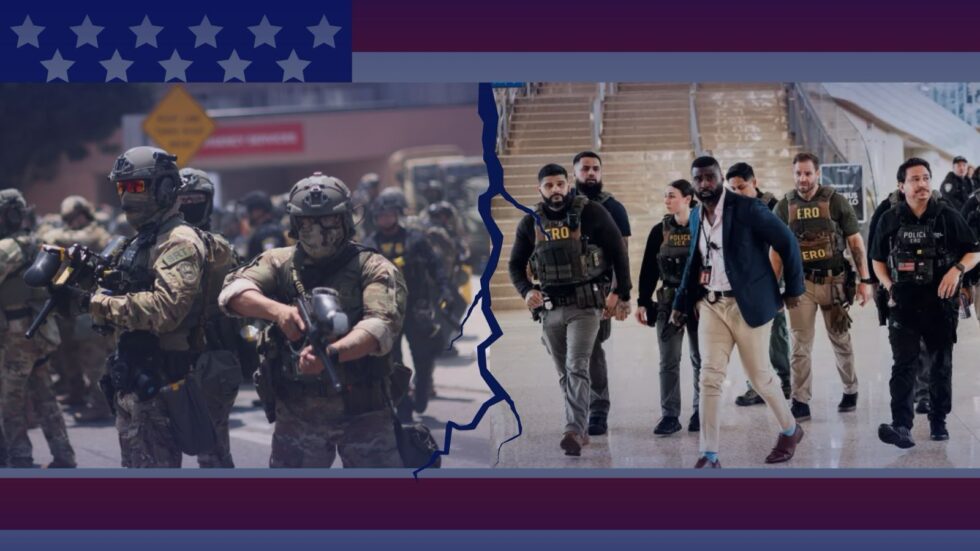


Unmasked Immigration and Customs Enforcement (ICE) agents have been deployed to major airports across America, stepping into Transportation Security Administration (TSA) operations amidst staffing shortages. This disruption follows a mid-February funding halt for the Department of Homeland Security (DHS) after Congress failed to come to an agreement regarding immigration reform. While ICE is unaffected by the partial shutdown, TSA employees have been working without pay for the last six weeks, culminating in long lines and flight delays in major American airports.
Officially, ICE’s stated role is limited: guarding entrances and exits, assisting with logistics, and supporting security operations. While ICE agents are not trained to operate TSA screening checkpoints, they are granted the power to check IDs and verify documentation. However, their growing presence in routine airport security signals something more than temporary “support.” It reflects the quiet expansion of immigration enforcement into everyday public spaces, raising deeper questions about the normalization of policing and surveillance under the cover of manufactured crisis.
Why ICE Agents Wear Masks
ICE agents commonly detain people while masked and dressed in civilian clothing, providing no indication that they are federal agents. DHS has reiterated time and time again that officers wear masks to prevent doxxing. To assess the justification, we must first understand the broader phenomenon of doxxing and its evolving role in the digital age.
In the age of social media and digital hyperconnectivity, doxxing has increasingly become a widespread social phenomenon, yet remains relatively under-theorized in legal terms. Doxxing refers to the publishing of an individual’s private or identifying information by an unauthorized individual or organization. This is done in order to expose, shame, and intimidate a target. In the aftermath of October 7th, universities became focal points for debates around doxxing. Many pro-Palestinian students were doxxed and few universities had policies in place to protect student privacy.
Many universities banned masking in response to backlash against pro-Palestinian student protests. Columbia University passed a mask ban as a part of the University’s deal with the Trump administration. This was after ICE began abducting students in 2025, beginning with former Columbia student Mahmoud Khalil. DHS used doxxing websites to identify student protesters to deport.
At the same time that ICE conceals its agents’ identities, it expands systems to identify and track the public. The recent deployment of unmasked ICE agents to airports shifts the dynamic. When masked, ICE frames itself as vulnerable against the perceived threat of doxxing and public scrutiny. When unmasked in airports, it normalizes public-facing authority in everyday spaces.
ICE Watchlists
Very little is publicly known about ICE’s watchlists precisely because they are developed and maintained covertly, often obscured by bureaucratic language and specific legal classifications. While officials may deny the existence of “watchlists” in a formal sense, investigative reporting by Ken Klippenstein and others has revealed a fragmented but expansive network of databases and tools that function as watchlists in all but name. Over a dozen of these secret watchlists are used to track anti-Ice and pro-Palestinian protestors, among others who are labeled “domestic terrorists.”
ICE has been building watchlists of Americans beyond the purview of the law for a while now. During arrests, ICE uses facial recognition technology to intimidate protestors and bystanders. Agents use a smartphone app called Mobile Fortify to scan peoples faces. These images are then compared to DHS’s Automated Biometric Identification System, a database of 270 million records. It also pulls driver’s licenses, passport photos, and other government data. This technology has been used over 100,000 times by DHS to scan people in public spaces without their consent.
Klippenstein writes that ICE uses multiple tools to aggregate tips, field reports, photographs, and videos from both the public and agents to generate what is called a “common operating picture.” This allows task forces to monitor individuals and map relationships by linking people via phone numbers, emails, and other contact data.
Additional programs, such as “masked engagement,” allow agents to infiltrate online spaces using false identities, gaining access to private accounts and group chats. This opaque surveillance infrastructure collects, connects, and stores information on both targeted individuals and those in their proximity with little clarity about how data is used, shared, or challenged.
Under the auspices of supporting TSA, through a crisis spurred by ICE’s lack of training and oversight, agents now stand in terminals where millions of Americans pass each day. These agents carry some of the most expansive yet secretive surveillance capabilities at a time when the government is obsessed with ‘proactively’ identifying domestic terrorists.
Moving Ahead
The recent deployment of ICE to airports should not be dismissed as a temporary fix to TSA staffing shortages. History shows that emergency measures, particularly those justified in the name of national security, rarely remain temporary. The Department of Homeland Security itself was created in 2002 as a direct response to 9/11. ICE was created in 2003 to merge immigration and customs agencies under DHS to integrate border control with investigative functions.
Airports are essential, unavoidable hubs that millions of people move through every day. A recent investigation by Reuters reveals that since Trump took office, ICE has arrested more than 800 people after receiving tips from TSA. Expanding enforcement authority beyond airports intensifies a broader pattern in which the agency selectively obscures itself while rendering the public increasingly visible and trackable.
Public awareness is critical. Travelers should understand their rights, question the normalization of expanded enforcement, and take steps to protect their data and privacy. The Intercept recently published a digital security guide outlining practical steps people can take to protect their personal data when flying.
Airports are spaces of transit, but the policies shaping them have lasting consequences. The question now is whether this expansion of authority will be scrutinized or absorbed into the background of everyday life.
If you value our journalism…
TMJ News is committed to remaining an independent, reader-funded news platform. A small donation from our valuable readers like you keeps us running so that we can keep our reporting open to all! We’ve launched a fundraising campaign to raise the $10,000 we need to meet our publishing costs this year, and it’d mean the world to us if you’d make a monthly or one-time donation to help. If you value what we publish and agree that our world needs alternative voices like ours in the media, please give what you can today.
Author

Related

The United States Used a Precision Missile in Lamerd, Iran, and Killed 21 Civilians within Seconds
The events that unfolded in the Iranian city of Lamerd on February 28, 2026, stand as a stark example of how the debut of a new weapon system can leave lasting scars on a community long after the explosions have faded.

10 Questions Karbala Still Asks Every Generation
The questions are not abstract. They are rooted in real figures and real moments from Karbala: Abbas ibn Ali at the Euphrates, Qasim ibn Hasan facing death as a teenager, Habib ibn Mazahir answering Husayn’s call as an elderly companion, the change of heart of the Umayyad commander Hurr on the morning of Ashura, the thirsty children in the camp, Imam Husayn standing almost alone, and Zainab carrying the story after the slaughter. Karbala still asks these questions because the moral significance of the event has never been exhausted.

What Gulf Repression Reveals About its Failure to Secure Sovereignty
The Gulf monarchies have long claimed a moral and religious legitimacy that their political conduct…