

Palestine is Not the Exception, it is the Prototype: The Future of AI Warfare
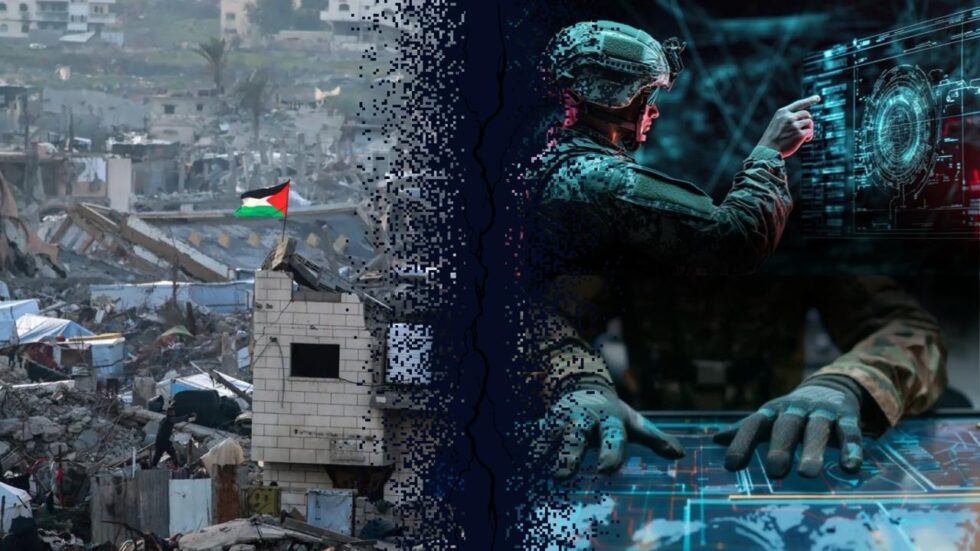


Gaza has long functioned as a testing ground for weapons and surveillance architecture. Yet, recent advancements in digital warfare and new administrative schemes to govern the Strip push this laboratory in a far more dangerous direction. What emerges are not merely battlefield experiments, but a scalable model of algorithmic violence, where artificial intelligence, biometric control, and outsourced governance converge to generate an exportable model of automated warfare.
The Architecture of Digital War
Since the end of the nineteenth century, international humanitarian law sought to limit the brutality of war. By the time of the 1991 Persian Gulf War, a new military doctrine coalesced around a vision of smart warfare that was more palatable to Americans in the aftermath of the Vietnam war. Precision-guided munitions and ‘smart’ weapons were presented as capable of minimizing both military and civilian casualties. The technological spectacle of the Gulf War was framed as a strategic and moral superiority, casting Western military power as precise, efficient, and therefore virtuous.
Framed as a more “humane” alternative to traditional forms of combat and occupation, modern digital warfare relies on remote drones, precision strikes, and algorithmic targeting. Digital warfare not only changed how wars are fought, but how they are justified and how much violence a society is willing to tolerate.
Digital war diverges from conventional war in both method and logic. Conventional warfare is conducted through direct, physical confrontation, premised on territorial control, identifiable battlefields, and the pursuit of decisive military victory. Its methods rely on the visible deployment of force against enemy combatants and civilian infrastructure alike.
By contrast, digital war operates through remote, data-driven systems that target information, perception, and decision-making processes rather than exclusively physical terrain. Its logic is oriented towards control and the continuous modulation of violence at a distance.
The Palestine Laboratory
Nowhere has this doctrine of digital war been refined more systematically than in Palestine. The aim is not limited to inflicting violence on a civilian population, but to build the skeletal framework of its use globally. The ‘Palestine Laboratory’ has become a term invoked by scholars to describe this trend, where Israel has used Palestine as a testing ground for weapons and security practices.
Scholars such as Darryl Li have long described Israel’s use of Palestinians to refine weapons and security practices. In 2006, Darryl Li wrote “The Gaza Strip as Laboratory: Notes in the Wake of Disengagement,” which argues that Gaza is a laboratory in which Israel maximizes control and minimizes responsibility. The military-industrial complex does not merely enable violence; it seeks to redefine reality so that violence ceases to appear as violence at all.
In parallel, Eyal Weizman published “Walking Through Walls,” which documented how Israeli forces breached homes during the Second Intifada by blasting through walls and transforming private homes into military spaces. Israel sought to dismantle what it termed “the infrastructure of terror” in the West Bank, and carried out a series of major attacks. Following international backlash after the Jenin Massacre in 2002, Israel refined its methods—adopting “smart destruction” strategies to inflict calibrated, lawful violence. The international outcry pushed Israel to improve “its art of destruction, which had apparently spun out of control.” Israel’s response was to better manage and market its violence.
Gaza represents one of the most sustained expressions of this model, visible in the aftermath of the October 10, 2025 ceasefire where the territory was divided along the “yellow line.” Territory east of the line came under Israeli control. Palestinians were forcibly expelled from half of Gaza, and the area was declared a combat zone. Despite the ceasefire, strikes and civilian casualties continued west of the line.
Rather than marking an end to the violence, the ceasefire reorganized it. Military infrastructure expanded along the divide. Land was cleared and consolidated. Recently, Forensic Architecture documented large-scale ground preparation near Rafah: land razed, rubble compacted, terrain leveled across a one-square-kilometer area adjacent to what has been described as a planned “humanitarian city.” This is what violence looks like when it becomes procedural rather than sensational.
An AI-abetted genocide
In the first weeks of Israel’s military campaign, the IDF deployed an AI system called “Lavender,” which identified around 37,000 Palestinians as bombing targets. According to an investigation by +972 Magazine, the Lavender AI system helped kill thousands of Palestinians by the end of October 2023.
Lavender operates through preset collateral thresholds. Between 15 to 20 civilian deaths are deemed acceptable for strikes for lower-level operatives, and over 100 for senior figures. Another AI tool, “Where’s Daddy?” is used to track targets to their family homes to ease the logistics of assassination.
The speed and scale of the violence that AI enables is unprecedented. Target lists that once required months of intelligence work can now be produced in seconds. Human oversight is reduced. Responsibility is diffused across layers of algorithms and databases. Existing legal systems are not structured to preemptively regulate such technologies in real time; the law responds only after the blood has dried.
Journalists like Antony Loewenstein have uncovered how the ‘Palestine Laboratory’ has long been a major selling point for Israeli exports. After every attack on Gaza, a range of weapons and surveillance technologies is marketed and sold to nations around the world. Major players in Israel’s arms industry, including Israel Aerospace Industries, Elbit Systems and Rafael Advanced Defense Systems sell weapons used in Gaza as “field-tested” and “battle proven.”
Currently, the ceasefire in Gaza is marked by continuous bombardment, the blocking of food and aid, and the rejection of humanitarian organizations and journalists. As civilians face preventable illness, exposure, and hunger, Israeli regulatory procedures and ongoing investigations obfuscate this violence as an administrative matter, with Western media outlets and governments silently acquiescing to this narrative.
Biometric Rule
If AI-assisted systems automated target generation, biometric governance automates the administration of life itself. Under this technocratic regime, everyday life is subject to algorithmic oversight and regulation.
On February 19, Donald Trump convened the inaugural meeting of the Board of Peace in Washington D.C. The stated objective was to raise funds to “reconstruct” Gaza. But unclassified slide decks, recently obtained by The Guardian and first reported by Dropsite, suggest a far more alarming development: details of an Emirati-financed plan to reconstruct Gaza through a regime of biometric governance. Under this proposal, Palestinians would enter the “planned communities” only after passing through security checkpoints and registering biometric data. This digital identification system would control access to services such as food, education, healthcare and shelter.
Forms of imperial governance are clearly formulated in Palestine. For decades now, Gaza has long functioned as a laboratory for weapons development and surveillance infrastructures that have ultimately been exported worldwide. However, the Board of Peace’s proposal signals a new phase in this laboratory, where administrative control and bureaucratic management will ultimately be outsourced to a foreign-led, unelected occupying force. At the board meeting, members talked explicitly about exporting this model of governance to other “hot spots” around the world. Under technofascism, billionaires and government leaders see anywhere there is conflict and scarcity as opportunities for investment. Gaza is only the beginning.
Palestine as the Prototype
When algorithms decide who lives and who dies, violence no longer depends on soldiers in the field but on data sets, pattern recognition, and automated lists of targets. War becomes scalable, calibrated, and administratively managed rather than formally declared. In Gaza, artificial intelligence and biometric control is reshaping imperial logic, transforming destruction into a system optimized for speed and tolerability.
Recently, the Pentagon refused a $200M contract with Anthropic’s Claude due to two exceptions. The AI company refused for its models to be used in “fully autonomous weapon systems” or “mass domestic surveillance” of Americans. Anthropic has since been blacklisted and deemed a threat to U.S. national security in an unprecedented move, never before applied to an American company. The U.S. government has instead opted for a deal with OpenAI’s ChatGPT, where AI will automate death and regulate life under surveillance without any human oversight.
What is unfolding in Palestine is not an anomaly confined to one territory. It is a prototype: a model of algorithmic warfare that may soon define how violence is conducted, justified, and exported around the world.
Sources
Ackerman, Elliot, and James Stavridis. “Drone Swarms Are about to Change the Balance of Military Power.” The Wall Street Journal, www.wsj.com/tech/drone-swarms-are-about-to-change-the-balance-of-military-power-e091aa6f.
Alberts, David S. Defensive Information Warfare, NATIONAL DEFENSE UNIV WASHINGTON , 1 July 1996, www.dodccrp.org/files/Alberts_Defensive.pdf.
Amoore, Louise. “Algorithmic War: Everyday Geographies of the War on Terror.” Antipode 41 (2009): 49-69.
Boichak, O., Hoskins, A. My war: participation in warfare. Digi War 3, 1–8 (2022). https://doi.org/10.1057/s42984-022-00060-7
Dowling, Paddy. “Dirty Secret of Israel’s Weapons Exports: They’re Tested on Palestinians.” Al Jazeera, November 17, 2023. https://www.aljazeera.com/features/2023/11/17/israels-weapons-industry-is-the-gaza-war-its-latest-test-lab.
Khurshudyan, Isabelle, et al. “Russia and Ukraine Are Fighting the First Full-Scale Drone War.” The Washington Post , www.washingtonpost.com/world/2022/12/02/drones-russia-ukraine-air-war/.
Li, Darryl, et al. “Anti-Palestinian at the Core: The Origins and Growing Dangers of U.S. Antiterrorism Law.” Center for Constitutional Rights (CCR) and Palestine Legal, Feb 24. 2024.
Li, Darryl. “The Gaza Strip as Laboratory: Notes in the Wake of Disengagement”, Journal of Palestine Studies, (2006). 35:2, 38-55, DOI: 10.1525/jps.2006.35.2.38
Loewenstein, Antony. The Palestine Laboratory: How Israel Exports the Technology of Occupation Around the World. Verso, 2023.
Merrin, Walter. Digital War: A Critical Introduction (1st ed.). Routledge. https://doi.org/10.4324/9781315707624
Said, Edward W., From Oslo to Iraq and The Road Map (Pantheon Books, 2004)
Stampnitzky, Lisa. Disciplining Terror: How Experts Invented “Terrorism.” Cambridge: Cambridge University Press, 2013. Print.
Weizman, Eyal, Hollow Land: The architecture of Israeli occupation (Verso, London 2007) Zureik, Elia, Constructing Palestine through Surveillance Practices (British Journal of Middle Eastern Studies, 2001)
Wezeman, Siemon, and Pieter Wezeman. “Trends in International Arms Transfers, 2013.” Stockholm International Peace Research Institute, March 2014.
Vera, Bergengrue. “Tech Companies Turned Ukraine into an AI War Lab.” Time, Time, 8 Feb. 2024, time.com/6691662/ai-ukraine-war-palantir/.
If you value our journalism…
TMJ News is committed to remaining an independent, reader-funded news platform. A small donation from our valuable readers like you keeps us running so that we can keep our reporting open to all! We’ve launched a fundraising campaign to raise the $10,000 we need to meet our publishing costs this year, and it’d mean the world to us if you’d make a monthly or one-time donation to help. If you value what we publish and agree that our world needs alternative voices like ours in the media, please give what you can today.
Author

Related

The Bane of Empire: Sayyed Hassan Nasrallah’s Legacy Endures
September 27, 2026, marks two years since Israel unleashed over 80 tons of bunker-buster bombs…

Trump’s 600 Days of Broken Promises
At the Republican midterm convention in Dallas on September 10th, President Donald Trump offered voters…

Eight Decades of Occupation: Kashmir’s People Still Deprived of Freedom
Just days ago, India and Pakistan marked 79 years since independence: Pakistan on 14 August…