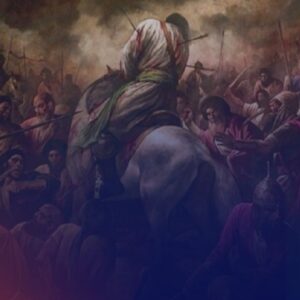

How This Year’s Arbaeen Became the Heartbeat of Resistance


Arbaeen marks the 40th day after Ashura, the day Imam Hussain ibn Ali was martyred at Karbala in 680 CE. It commemorates the moment when the surviving members of the Prophet’s household, the Ahl al-Bayt, including Imam Zain al-Abidin and Lady Zainab were brought from Damascus back to Karbala, where they visited Imam Hussain’s grave for the first time since his martyrdom. For Shia Muslims, this journey is not merely historical; it is the archetype of return to truth after exile, of bearing witness to martyrdom after surviving tyranny.
Every year since, people from over 100 countries have walked the 80-kilometer route from Najaf to Karbala, recreating this pilgrimage in bodily form. The walk itself becomes a covenant: millions shoulder to shoulder, rich and poor, Arab and non-Arab, all moving toward the shrine of the Imam who refused to legitimize Yazid’s usurpation. For Shia Muslims, Imam Hussain’s martyrdom is not passive mourning but an active paradigm: the choice between silence before injustice or sacrifice in defense of truth. The “Karbala paradigm,” as scholar Syed Akbar Hyder describes it, provides a model for resisting oppression that transcends time – each generation finding its own Yazid, its own Karbala, its own moment of choice.
Arbaeen has always been a covenant, through which those walking toward Karbala reaffirm their allegiance to Imam Hussain’s stand against tyranny. However, in 2026, that covenant takes on new meaning: it becomes a demonstration of the Axis of Resistance’s strength, unity, and refusal to be fragmented by aggression. From the assassination of Sayyid Ali Khamenei to the U.S.-Saudi airstrikes on pilgrims in Iraq; from Yemen’s defiant retaliation against Saudi Arabia to Bahrain’s crackdown on Shia clerics and Hezbollah and the major Shia factions of the PMF’s refusal to disarm. For the Axis of Resistance and many of its supporters, Arbaeen in 2026 has emerged not merely as a pilgrimage but as a political and spiritual statement. This is what makes it different: it is the moment when the theology of Karbala finds its fullest expression in the landscape of resistance.
The “Martyred Leader of the Islamic Revolution”: The Transformation of a Movement
Sayyid Ali Khamenei was assassinated on February 28, 2026, in a joint U.S.-Israeli airstrike on Tehran. His body, per his own wish, was also carried to Karbala. It was the first time a Leader of Iran’s Islamic Revolution had visited Karbala after assuming leadership, and that too after being honored as the “Martyred Leader of the Islamic Revolution” and as the central figure of the Axis of Resistance. This gave rise to an unprecedented message. Between July 3 and July 9, an estimated 41 to 43 million mourners passed through his funeral processions across Iran and Iraq, with 10 million converging on Najaf and Karbala alone. Sources called it the largest funeral in human history. Whether the exact figure is debated matters less than what it signifies: his assassination fused with Imam Hussain’s martyrdom in the collective consciousness of the Axis of Resistance, transforming Arbaeen from commemoration into living testimony of defiance.
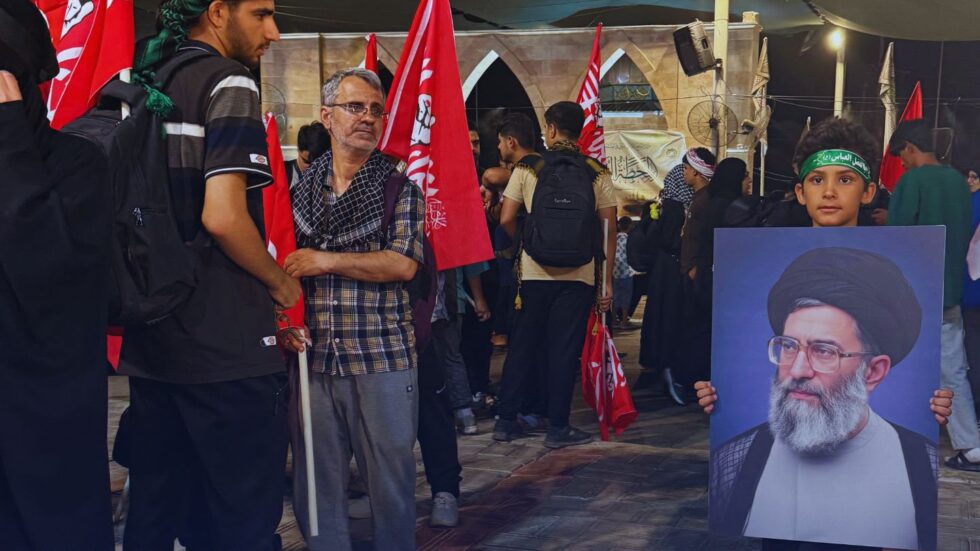
Along the Najaf-Karbala route, red flags, symbolizing the call for justice, waved alongside portraits of Sayyid Ali Khamenei and his successor, Sayyid Mojtaba Khamenei. Eulogies echo from hospitality stations (mawakib), reframing the pilgrimage as a statement of unity against “present-day Yazids.” For the Axis of Resistance, Ayatollah Khamenei’s martyrdom is not an endpoint, but a catalyst. His funeral became the largest mobilization in the movement’s history, demonstrating that decapitation strikes do not fracture resolve, they deepen it.
The Siege of the Pilgrimage
The Al Khalifa regime in Bahrain banned all citizens from traveling to Iraq and Iran for pilgrimage on June 3, 2026, citing “security concerns.” Security forces raided homes across the island, arresting at least 20 Shia Muslims, including five prominent clerics: Syed Yasin Mousawi, Sheikh Ali Al-Mustarshid, Sheikh Jafar Ashour, Sheikh Nazir Malik, and Sheikh Mahmood Taheri. Nineteen Hussaini eulogists were barred from organizing mourning gatherings for one year. Al Wefaq, Bahrain’s largest Shia opposition group, documented mass detentions designed to prevent Arbaeen participation. The crackdown intensified as Muharram processions began, with authorities reviving 2011 repression methods: mass arrests, travel bans, and systematic silencing of Shia religious expression.
In the UAE and broader Gulf, the repression took a different form: expulsion. Since late February 2026, approximately 7,500 Pakistani Shia nationals were deported from the UAE, with some estimates reaching 15,000 affected individuals. Over 5,000 Pakistani Shia families had their residency permits cancelled and were sent home. These deportations occurred amid the U.S.-Israel war on Iran, framing Shia identity itself as a security threat. Pilgrims who would have walked to Karbala are instead scattered across airports and detention centers, their covenant reduced to smuggled prayers and whispered eulogies. Detainees recounted torture and abuse during deportation proceedings, with human rights organizations documenting systematic targeting of Shia migrants.
On July 29, 2026, days before Arbaeen’s peak, U.S.-Saudi joint airstrikes hit a pilgrim service station (mawkib) near Checkpoint 45 on the Karbala-Baghdad road. Preliminary reports cite at least 20 members of the Popular Mobilization Forces (PMF) were killed, while 32 were wounded in coordinated strikes that targeted seven Iraqi provinces. Saudi Arabia officially accepted responsibility for the attacks, which analysts describe as an attempt to disrupt Islamic unity and divert attention from failures on the Yemen front. The images circulated among pilgrims: Mohammed bin Salman depicted on trash cans, a visual language of popular rejection that spreads through WhatsApp groups and Instagram stories along the Najaf-Karbala route. Iraqi media activists frame the aggression as a new scenario to disrupt Islamic unity on the eve of Arbaeen.
For the Axis of Resistance, these attacks do not deter, they galvanize. Every arrested cleric, every deported pilgrim, and every targeted resistance member becomes a node in the network of defiance. The siege of the pilgrimage demonstrates what the Axis already knows: repression is the price of resistance, and they are willing to pay it.
The Refusal to Disarm: Weapons as Covenant
In Lebanon, Hezbollah Secretary-General Sheikh Naim Qassem rejected U.S.-mediated disarmament proposals with characteristic clarity: “Disarmament is extermination, and this is something we cannot accept.” The Lebanese government’s four-month timeline for disarmament is dismissed as a misstep serving Israeli interests. Qassem emphasized that Hezbollah’s weapons constitute Lebanon’s defensive capability against continued Israeli aggression. On June 17, 2026, Qassem unequivocally stated that the group will reject any proposal linked to disarmament, stressing that negotiations with Israel should not include weapons surrender. Hezbollah ministers walked out of government sessions in protest of the disarmament plan.
In Iraq, Kataib Hezbollah and other Popular Mobilization Forces (PMF) factions pledged refusal to disarm until foreign troops withdraw from Iraqi soil. Kataib Hezbollah declared it will only surrender weapons to the Imam Mahdi, the twelfth Shia Imam, signaling eschatological resistance. Multiple resistance groups, including Harakat Hezbollah al-Nujaba and the Islamic Resistance in Iraq, affirmed their rejection of disarmament frameworks. On April 7, 2025, Kataib Hezbollah had already denied reports it was considering disarmament, setting the stage for 2026’s firm stance. Hezbollah and Iranian leaders continued to reject any ceasefire framework in Lebanon that does not meet their maximalist demands.
This defiance is not peripheral to Arbaeen 2026; it is central. The pilgrimage has always been about the choice between silence and sacrifice. When Hezbollah and PMF refuse to lay down arms, when Bahraini clerics preach eulogies from prison cells, when deported Shias carry Karbala in their hearts, they are enacting the same choice Hussain made at Karbala in 680 CE. For the Axis of Resistance, weapons are not viewed merely as instruments of war, but as symbols of a broader commitment rooted in Imam Hussain’s legacy: that oppression and injustice must be confronted through resistance.
Yemen: The Southern Front of the Axis
Saudi Arabia’s aggression on Yemen resumed with renewed intensity in July 2026. On July 13, Saudi-led coalition forces attacked Sanaa International Airport’s runway to prevent an Iranian plane from landing, in what the Yemeni Transport Ministry described as a U.S.-Israeli-backed effort to tighten Saudi Arabia’s blockade on Yemen’s ports and airports. Ansarallah’s retaliation included dozens of ballistic missile and drone strikes targeting Abha International Airport in southern Saudi Arabia, the imposition of a maritime blockade on Saudi-linked vessels transiting the Bab al-Mandab Strait, and attacks on Saudi oil infrastructure, including the Aramco refinery in Jizan.
Following Saudi’s aggression, Ansarallah leader Abdul Malik al-Houthi accused Saudi Arabia of acting as a vehicle for U.S. and Israeli interests in West Asia, stating that Riyadh was helping advance a regional agenda designed to sow division and instability. Vowing that Yemen would not yield to external pressure, al-Houthi declared:
We will spare no effort in confronting Saudi Arabia with everything we possess, seeking God’s help and placing our trust in Him… Neither Saudi Arabia, nor its American, British, and Israeli masters, nor anyone in this world will be able to enslave us or confiscate our freedom and dignity.”
He went on to cast Washington and Tel Aviv as the architects of global instability, describing them as “the root of evil and instability worldwide” and accusing them of sustaining their influence through war, coercion, and the plunder of nations’ wealth, “from Palestine to other regions.”
This front is not separate from Arbaeen; it is woven into it. Chants of “Down with U.S. and Israel” echoed from hospitality stations (mawkibs) along the Najaf-Karbala route, linking the pilgrimage to Yemen’s resistance against empire. The same logic that drives Hussain’s stand refusal to legitimize tyranny animates Yemen’s fighters, Iraq’s resistance factions, and Lebanon’s Hezbollah.
For the Axis of Resistance, Yemen is not a forgotten front, it is a proving ground. When pilgrims chant for Yemen along the road to Karbala, they are not expressing sympathy; they are acknowledging kinship. Within the worldview of the Axis of Resistance, the struggles of Yemen, Lebanon, Iraq, and Palestine are understood through the same moral vocabulary of Karbala.
The Walk That Never Ends
Arbaeen teaches that the journey to Karbala is never truly complete; it is renewed each year as millions return to reaffirm the values embodied by Imam Husain’s stand against injustice. In 2026, that message carries renewed weight for many pilgrims, resonating through the struggles of the present: from those killed in US-Israeli aggression across the region, to the repression and imprisonment faced by Shia communities under Arab regimes, to the growing pressures placed on resistance movements to disarm. Millions still walk.
This is the paradox of Arbaeen: the more aggression intensifies, the more the covenant solidifies. Sayyed Khamenei’s body in Karbala, the red flags symbolizing revenge, the chants against the United States and Israel, the refusal to disarm, all are manifestations of a single truth: Hussain’s choice is theirs, every year, every step.
The road to Karbala has always been a road of defiance. This year, it becomes something more: a reckoning. Not just of what is lost, but of what remains unbroken. The covenant of Hussain endures, not in spite of the blood and dust, but because of it.
For the Axis of Resistance, Arbaeen 2026 was not only a pilgrimage. It is a mobilization. It is the annual demonstration that no airstrike, no deportation, no arrest campaign, no disarmament ultimatum can break the bond between Karbala and the present, between Hussain and those who carry his name into every front.
The walk continues. The covenant holds. The Axis stands.
If you value our journalism…
TMJ News is committed to remaining an independent, reader-funded news platform. A small donation from our valuable readers like you keeps us running so that we can keep our reporting open to all! We’ve launched a fundraising campaign to raise the $10,000 we need to meet our publishing costs this year, and it’d mean the world to us if you’d make a monthly or one-time donation to help. If you value what we publish and agree that our world needs alternative voices like ours in the media, please give what you can today.
Author

Related
Islamic Unity Week Held in Honor of Holy Prophet Muhammad’s Birth
This past week, nearly two billion Muslims from all over the world celebrated the birth…
Muharram in the Age of Algorithms: Remembering in a World That Teaches Us to Forget