

Eight Decades of Occupation: Kashmir’s People Still Deprived of Freedom
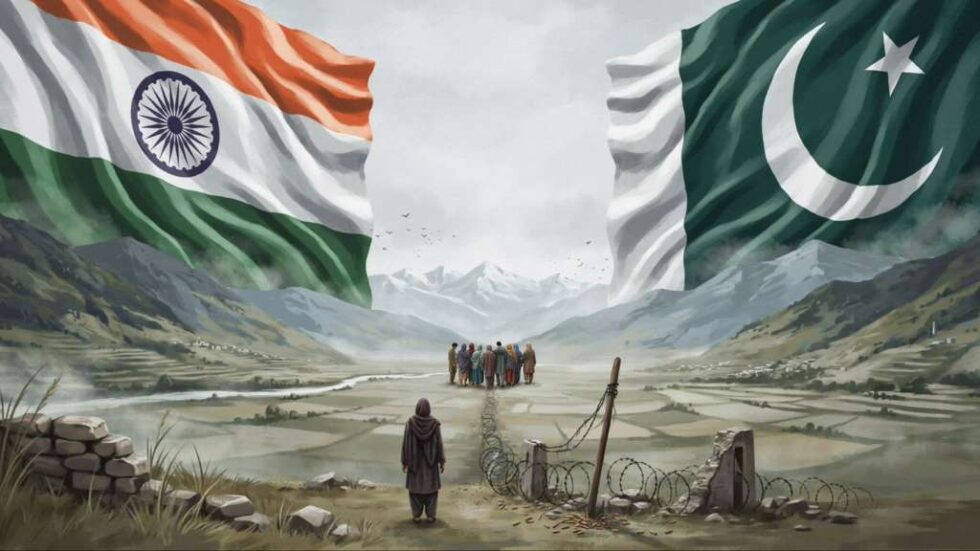


Just days ago, India and Pakistan marked 79 years since independence: Pakistan on 14 August and India on 15 August. Two states, born from the end of British rule in 1947, once again raised their flags in celebration of freedom, sovereignty, and national destiny.
Between those two flags lies Kashmir.
For nearly eight decades, Kashmir has remained divided and subjected to competing forms of military and political control. Its territory has been partitioned, its people governed by states that claim sovereignty over their homeland, and its political future repeatedly decided in their name.
Kashmir is routinely reduced to a “dispute” between India and Pakistan: a territory on a map, a border question, a diplomatic file, a site of military escalation.
But Kashmir is not a dispute.
It is a homeland under occupation and division. It is a people whose political aspirations have repeatedly been subordinated to the interests of competing states. It is a struggle for freedom whose central subject has often been erased from the language used to describe it.
For Kashmiris, Kashmir is not a diplomatic file, a border question, or an abstract territorial dispute. It is home. And when Kashmir is reduced to a question of which state should control that home, Kashmiris themselves disappear from the center of the story.
The difference in scale, history, and legal architecture between Indian-occupied Kashmir and Western Kashmir, or Pakistan-administered Kashmir, should not be erased. Yet neither should those differences become an excuse for two separate moral standards. New Delhi and Islamabad invoke different nationalist narratives, but both have repeatedly treated Kashmiri people as instruments of state policy: symbols when nationalism requires a symbol, bargaining chips when diplomacy requires leverage, and security threats when Kashmiris insist on speaking for themselves.
That is Kashmir’s tragedy. It has been caught between two flags for nearly eight decades, and made to pay the price for both.
Kashmir’s Struggle Did Not Begin With India and Pakistan
The history of Kashmir cannot begin with the flags of India and Pakistan. Long before India and Pakistan went to war over Kashmir, Kashmiris were already fighting for political freedom. In 1946, the Quit Kashmir movement challenged Maharaja Hari Singh and the Dogra monarchy, In 1946, the Quit Kashmir movement challenged the authority of Maharaja Hari Singh and the Dogra monarchy, rejecting the idea that Kashmir could be the hereditary property of a ruler rather than the political home of its people.
The movement’s political argument was fundamental: Kashmir could not be treated as the personal property of a monarch, to be ruled or transferred according to the wishes of a sovereign above the people. The future of Kashmir had to be determined by Kashmiris.
Sheikh Abdullah’s statement in court during the Quit Kashmir campaign articulated this principle in unmistakable terms: the people, rather than the ruler, had to be the source of political authority. Prem Nath Bazaz likewise argued that neither an outside power nor the Maharaja possessed the moral authority to decide Kashmir’s political future on behalf of its people.
This history is vital because it exposes one of the central distortions in the modern telling of Kashmir. The question was never simply which flag should fly over Kashmir. Kashmiris themselves had a political struggle, a conception of sovereignty, and aspirations for freedom before India and Pakistan turned Kashmir into the central object of their competing national claims.
The Partition of British India did not erase that political agency. It displaced it.
The Plebiscite That Never Came
The United Nations entered the Kashmir question after India and Pakistan had already turned Kashmir into a battlefield. UN Security Council Resolution 47, adopted on 21 April 1948, called for conditions to be created for a free and impartial plebiscite through which the question of Jammu and Kashmir’s accession to India or Pakistan would be decided.
The resolution laid out a sequence of demilitarization and restoration of conditions for the vote, including the withdrawal of tribesmen and Pakistani nationals who had entered the state to fight, followed by the reduction of Indian forces to the minimum necessary for maintaining “law and order”.
But the significance of the framework for Kashmiris lies not in which state was asked to withdraw first. It lies in what never happened: the people of Jammu and Kashmir were never given the promised opportunity to decide.
India and Pakistan would spend decades disputing the conditions, the sequence, and responsibility for the failure of the process. The political question was repeatedly pushed back into negotiations between states, while the people at the center of the question remained without the promised vote.
The plebiscite never came.
And that failure should not be mistaken for a resolution of the question. It did not transform the presence of either state into the consent of the Kashmiri people. Nor did decades of military control erase the political principle that Kashmiris themselves had the right to determine their future.
There was another limitation to the UN framework: the proposed plebiscite was framed as a choice between accession to India or Pakistan. It did not offer independence as an option. That matters because Kashmiri political aspirations had never been exhausted by the claims of the two states surrounding them.
The political horizon was therefore narrowed to two competing states, even as Kashmiri political movements continued to assert that Kashmir’s future belonged to its people. In 1965, Amanullah Khan, Abdul Khaliq Ansari, and Maqbool Bhat helped establish the Azad Kashmir Plebiscite Front, a formation rooted in the demand that the people of the whole former princely state determine their future. Its United Kingdom chapter was later reconstituted as the Jammu and Kashmir Liberation Front in 1977. The JKLF became one of the most prominent organized expressions of the demand for an independent, reunified Kashmir, neither India nor Pakistan.
This is why the question cannot be reduced to the failure of an India-Pakistan settlement. The political aspiration for an independent Kashmir did not disappear simply because the UN framework excluded it. It continued to exist within Kashmir’s own political history.
For decades, international recognition of the question has therefore existed alongside political paralysis. Kashmir remains on the agenda, but being placed on an agenda is not the same as being free.
A question can be discussed for generations and still be managed in ways that prevent the people most affected from becoming the authors of its resolution.
The language of resolutions, dialogue, and process has often become a substitute for confronting what has happened on the ground: militarization, surveillance, detention, demographic and political restructuring, censorship, and the shrinking space for Kashmiris to organize independently.
The plebiscite never came. The occupation remained. And the world learned to call the resulting condition a “dispute.”
India’s Freedom, Kashmir Under Occupation
In Indian-occupied Kashmir, ordinary life continues under a brutal military occupation. The region has long been described as the world’s most militarized, with an extensive security apparatus of troops, checkpoints, raids, surveillance, and security operations woven into everyday life.
The scale of the military presence is enormous. However, occupation is not measured only by troop numbers. It is experienced through the laws that empower security forces, the surveillance that follows ordinary people, the detentions that can remove young men from their families without trial, and the constant knowledge that political dissent can bring the state to a family’s doorstep.
This order is reinforced through draconian laws that grant the occupation extraordinary powers. The Armed Forces Special Powers Act, or AFSPA, provides security forces with extensive powers of search, arrest, and use of force while creating significant barriers to accountability. The Public Safety Act, or PSA, permits preventive detention without trial. The Unlawful Activities (Prevention) Act, or UAPA, India’s principal counterterrorism law, has been used against journalists, activists, students, and human-rights defenders.
These laws are not abstract legal instruments. They riddle everyday life with fear. A young person can be labeled a “sympathizer,” an “overground worker,” or a “facilitator,” and that label can trigger interrogation, detention, surveillance, and years of legal uncertainty. The presumption of innocence becomes almost meaningless when the accusation itself is enough to bring the security state to a family’s door.
In July 2026, after Head Constable Ashiq Hussain Qureshi was killed in Anantnag mysteriously, authorities launched sweeping operations across the Kashmir Valley, with reports placing the number of detainees at more than 3,500, including roughly 700 in Srinagar.
The crackdown also reportedly included the demolition of homes linked by authorities to alleged armed-group members. This follows a broader pattern in which demolitions have been used alongside security operations, creating fear far beyond the individual accused by the authorities. Such actions are regularly presented under the language of counterterrorism to break the collective will of the people.
This is how the military apparatus exerts its power over an entire population: not merely by targeting individuals, but by creating an atmosphere in which entire families and communities understand that the state can reach into every part of their lives.
Amnesty International has previously condemned demolitions in Kashmir, warning that houses and businesses have been destroyed without adequate due process and that punitive demolitions can constitute collective punishment. The logic is devastatingly simple: the state does not only target the person it identifies as an accused individual; it extends punishment outward to parents, siblings, spouses, children, neighborhoods, and entire communities.
Kashmiris have also lived with a long record of sexual violence associated with occupation, militarization, and impunity and it continues to be used as a weapon of war to break Kashmiri will. The darkest chapter of this remains the Kunan-Poshpora mass-rape incident when on February 23, 1991, the twin villages of Kunan and Poshpora in the Kupwara district of Kashmir became the site of mass sexual assault. During a night search operation by the 4th Rajputana Rifles of the Indian Army, troops gathered local men outside for interrogation and torture while soldiers systematically gang-raped numerous women inside the homes.
Sexual violence belongs to the broader political structure of occupation: when armed power operates with impunity, women’s bodies can become another terrain over which control is asserted.
The case of Khurram Parvez illustrates how dissent itself can be criminalized. The Kashmiri human-rights defender was arrested in November 2021 under provisions of the Unlawful Activities (Prevention) Act. Rights organizations have described his detention as arbitrary and politically motivated. In July 2026, the Delhi High Court granted him bail after more than four and a half years in custody. His case illustrates the profound consequences of prolonged pretrial detention in politically sensitive cases.
This is what a society governed through suspicion under occupation looks like: arrest first, accountability later, if it comes at all.
Western Kashmir: When the “Kashmir Cause” Turns Against Kashmiris
Across the Line of Control, Pakistan presents itself as the defender of Kashmiri self-determination. Its condemnation of Indian repression is often justified.
But a state cannot invoke Kashmiri freedom abroad while denying political freedom to Kashmiris under its own control.
In Western Kashmir, the Jammu Kashmir Joint Awami Action Committee (JKJAAC) emerged as a grassroots movement of traders, lawyers, civil-society groups, workers, and activists demanding political representation, affordable electricity, improved public services, accountability, and relief from economic hardship. One major political demand concerned the abolition of 12 legislative seats reserved for refugees from Indian-occupied Kashmir living elsewhere in Pakistan, an arrangement critics argue weakens local representation.
These are not vague political requests.
They are demands about life: electricity bills, healthcare, representation, livelihoods, governance, and the right to be heard.
Yet on 5 June 2026, authorities designated the JKJAAC a “proscribed organization” under the Azad Jammu and Kashmir Anti-Terrorism Act, 2014. Amnesty International called the move a dangerous escalation, warning that the crackdown had included an internet shutdown, arbitrary arrests, and deadly force against protesters.
By late July, Amnesty International, citing media reports, had documented at least 40 deaths in the context of the unrest, including 34 protesters and six police and paramilitary personnel while other local accounts reported substantially higher figures. There were also reports of scores of bodies disappearing, further complicating efforts to establish an accurate toll. With communications still restricted and no comprehensive, independent accounting immediately available, the precise number of those killed remains contested. But even the most conservative documented figures are deeply disturbing, while reports and eyewitness accounts now suggest that the death toll may have approached, or even exceeded, 100.
The central fact remains: people died while demanding basic political and economic rights from authorities claiming to represent them.
The communications blackout was itself part of the repression. Within this context, internet and mobile restrictions isolate communities, impede journalism, disrupt education and livelihoods, and make it harder for families to contact one another.
More crucially, when lethal force is used, a blackout reduces the ability of witnesses to document what happened.
It does not simply restrict speech; it restricts evidence.
Pakistan has long argued, correctly, that communication shutdowns in Indian-occupied Kashmir cannot be dismissed as neutral security measures. However, that principle has not been consistently applied in Western Kashmir. Human dignity does not change when one crosses the Line of Control.
A government does not become a defender of self-determination merely by invoking the word Kashmir. Self-determination means little if Kashmiris are permitted to speak only when their speech serves someone else’s national project.
Two flags, One Political Logic
The repression on the two sides is not identical. Indian-occupied Kashmir has endured a distinct and deeper architecture of military occupation, legal impunity, demographic intervention, and political repression. Flattening that reality into a false equivalence would be dishonest.
But asymmetry does not create a moral exemption for Pakistan. Recognizing the scale and character of India’s occupation does not require Kashmiris to accept repression by authorities on the other side of the Line of Control.
The flags are different. The uniforms are different. The language is different.
New Delhi invokes counterterrorism, territorial integrity, and national unity. Islamabad invokes Kashmir’s cause, public order, and security. But when Kashmiris organize autonomously, when they demand representation, question governance, resist dispossession, or reject being spoken for, the response can become coercion rather than dialogue.
This is the deeper political tragedy: both states have repeatedly claimed to speak about Kashmir while Kashmiris themselves are denied the authority to speak for Kashmir.
This is why Kashmir continues to function as a bargaining chip.
It is useful to both states as an unresolved wound. Nationalist parties can mobilize around it. Security establishments can justify exceptional powers through it. Governments can trade it as diplomatic leverage. Diaspora institutions can build careers around narrating it.
Meanwhile, Kashmiris absorb the consequences.
They are families rebuilding homes after demolitions. They are young people detained without clear charges. They are students unable to access classes during internet shutdowns. They are workers who cannot earn. They are women carrying memories of violence that the state would prefer to erase. They are protesters demanding electricity, healthcare, dignity, and representation.
They are not security statistics. They are not props in nationalist theater. They are not evidence for either India’s or Pakistan’s preferred story. They are Kashmiris.
A Freedom Still Deferred
The struggle of Kashmiris began against autocratic rule before Partition was ever erased by the arrival of two new flags. The demand for Kashmir’s future to be determined by its people did not begin with the United Nations, and it did not disappear when India and Pakistan claimed competing rights over the territory.
The promised political choice was never delivered. The plebiscite never took place. Decades of occupation, division, and state management have not transformed Kashmir into the property of the states that control it.
Kashmir belongs first to the people who call it home.
India and Pakistan celebrate their independence as Kashmiris are still waiting for the freedom to decide what freedom means for themselves.
If you value our journalism…
TMJ News is committed to remaining an independent, reader-funded news platform. A small donation from our valuable readers like you keeps us running so that we can keep our reporting open to all! We’ve launched a fundraising campaign to raise the $10,000 we need to meet our publishing costs this year, and it’d mean the world to us if you’d make a monthly or one-time donation to help. If you value what we publish and agree that our world needs alternative voices like ours in the media, please give what you can today.
Author

Related

The Bane of Empire: Sayyed Hassan Nasrallah’s Legacy Endures
September 27, 2026, marks two years since Israel unleashed over 80 tons of bunker-buster bombs…

Trump’s 600 Days of Broken Promises
At the Republican midterm convention in Dallas on September 10th, President Donald Trump offered voters…
How Ansar Allah’s Resistance Exposed Gulf Powerlessness
The Arab world does not suffer from a shortage of weapons. It suffers from a…