

Thanksgiving: Genocide Rewritten as Gratitude
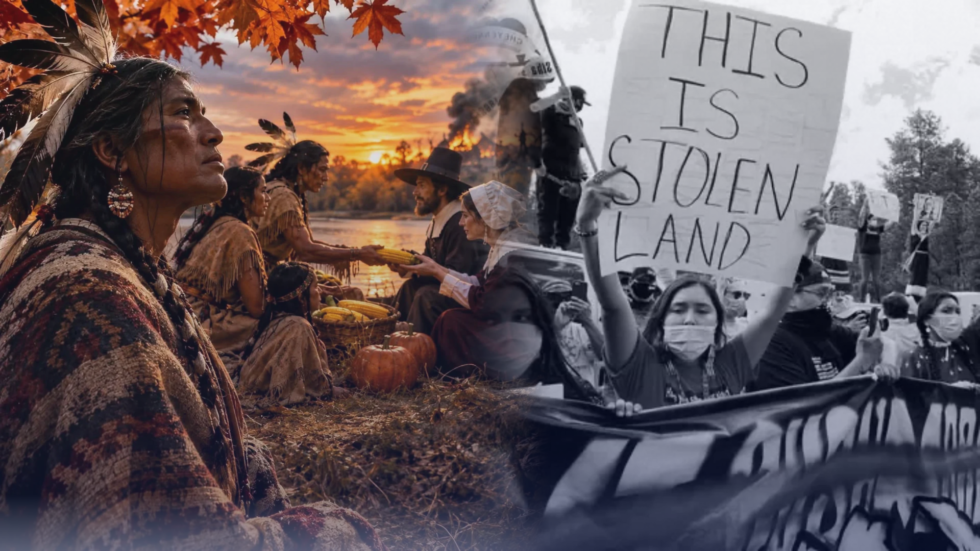


Every American schoolchild is familiar with the story of Thanksgiving. The Pilgrims, having endured the hardships of settling in a new land, are welcomed by the Native Americans. Together, they gather around a table, share the fruits of their harvest and celebrate a spirit of friendship, gratitude and peaceful coexistence.
It’s a heartwarming, comforting story. It’s also a sanitized account of America’s colonial and genocidal foundations.
History Repeats
The dispossession of Indigenous peoples, the seizure of their lands and the destruction of their communities are widely recognised as historical injustices. Yet, in the United States, the history of European colonization has been romanticized through one of the nation’s most cherished holidays.
The dispossession of Indigenous peoples is not a phenomenon confined to America’s past. From the Americas to Palestine, the seizure of land and the displacement of its inhabitants have been accompanied by narratives that legitimize colonial conquest.
Thanksgiving provides a particularly revealing example of how such narratives can become so deeply embedded in national consciousness that the injustices they obscure are rarely called into question.
To understand how this narrative became enshrined in American founding mythology, we must return to Plymouth in 1620.
The Real Thanksgiving
When the Mayflower arrived on the shores of what is now modern-day Massachusetts, the English settlers encountered a land that had been inhabited by Indigenous peoples for thousands of years. The Wampanoag, whose communities had recently been devastated by disease introduced through European contact, were navigating an increasingly precarious political landscape.
In 1621, the Wampanoag leader Ousamequin, commonly known as Massasoit, established an alliance with the English settlers. Far from being simply an act of hospitality, the agreement was a strategic political decision intended, in part, to strengthen the Wampanoag against rival Indigenous nations.
Later that year, the English settlers and the Wampanoag participated in the harvest gathering that would eventually become popularized as the first Thanksgiving.
What is considerably less familiar to the American public is the history of colonial violence that followed.
Just sixteen years after the celebrated gathering, English colonists perpetrated one of the most notorious massacres in the early history of New England.
In May 1637, during the Pequot War, English colonial forces attacked a Pequot village in what is now Mystic, Connecticut. Between 400 and 700 Pequot people, including women, children and the elderly, were killed.
The massacre was justified by colonial figures through religious rhetoric, with the killing of women and children defended through biblical references.
The subsequent Treaty of Hartford in 1638 sought to extinguish the Pequot as a distinct political and cultural entity. Survivors were enslaved, dispossessed of their ancestral lands and prohibited from identifying themselves as Pequot.
These were not simply territorial disputes between competing populations. The mass killing, enslavement and deliberate suppression of Indigenous identities were manifestations of the broader genocidal campaign that accompanied European colonization in North America.
As English settlements continued to expand throughout New England, Indigenous nations faced mounting pressure to surrender their lands, submit to colonial jurisdiction and relinquish their political autonomy.
By 1675, just over half a century after the celebrated harvest gathering, these tensions culminated in King Philip’s War. Leading the Wampanoag resistance was Metacom, the son of the very man whose alliance with the colonists is commemorated every Thanksgiving.
The war brought catastrophic consequences for the Indigenous population. Historical estimates suggest that between 40 and 50 percent of southern New England’s Indigenous population had been killed by the end of the war.
Indigenous villages were destroyed, families were permanently separated, and hundreds of captives were sold into slavery in the Caribbean. Even those who surrendered to colonial authorities were not guaranteed protection, with many subjected to execution, enslavement and forced relocation.
By the end of the war, the political and demographic landscape of New England had been fundamentally transformed. According to The American Yawp, Indigenous peoples constituted approximately 25 percent of New England’s population in 1670. A decade later, that figure had fallen to approximately 10 percent.
This history seldom occupies a place alongside the familiar images of Pilgrims and Native Americans sharing a meal. A single moment of cooperation has instead come to overshadow generations of destruction and dispossession.
The transformation of Thanksgiving into a national tradition occurred centuries later. In 1863, amid the American Civil War, President Abraham Lincoln proclaimed a nationwide Thanksgiving observance. Throughout the nineteenth century, the Plymouth gathering was increasingly fashioned into an idealized origin story for the American nation.
However, Indigenous Americans have long contested the historical narrative upon which Thanksgiving is founded.
In 1970, Wampanoag activist Wamsutta Frank James was invited to speak at an event commemorating the 350th anniversary of the Pilgrims’ arrival. When organizers objected to his prepared address, which confronted the historical mistreatment of his people, James refused to deliver a sanitized alternative.
That year marked the beginning of the National Day of Mourning, an annual observance in Plymouth commemorating Indigenous suffering, resistance and survival.
The competing interpretations of Thanksgiving raise a broader question: whose experiences are afforded a place in our understanding of history?
This question extends beyond the American continent.
Different Lands, Familiar Injustices
Centuries after European settlers laid claim to Indigenous lands in the Americas, a comparable process of settler colonialism unfolded in Palestine.
In 1948, approximately 750,000 Palestinians were forcibly expelled or driven from their homes, thousands were killed, and more than 500 Palestinian villages were destroyed. Entire communities that had existed for generations were erased from the geographical landscape to make way for a new colonial order.
Palestinians remember this as the Nakba, meaning catastrophe, while Israel commemorates the same historical period as its independence.
Much like the European colonial portrayal of Indigenous America as an unexplored frontier, the Zionist narrative of Palestine as “a land without a people for a people without a land” obscured the existence of an established population with its own society, culture, political aspirations and authority over the land.
The parallels with Indigenous America extend beyond the seizure of land. They lie in the construction of national narratives that whitewash colonial conquest while concealing the carnage upon which it was founded.
In North America and Palestine alike, the experiences and aspirations of settlers are afforded a privileged place in collective memory, while the destruction of Indigenous communities is relegated to its margins.
The Selective Condemnation of Genocide
However, the genocide of Indigenous Americans in particular is subject to a glaring double standard within the remembrance and condemnation of historical atrocities.
While other genocides are remembered with solemnity and their perpetrators condemned, the history of European colonization in America has been sufficiently romanticized to form the backdrop of a national celebration.
The passage of centuries does not lessen the gravity of an atrocity, nor does the consolidation of colonial power legitimize the violence upon which it was founded.
Historical understanding and objectivity are reflected not in the willingness to condemn atrocities widely recognized as such, but in the willingness to confront those that have been woven into the fabric of national identity.
Thanksgiving should invite precisely that kind of reckoning.
If you value our journalism…
TMJ News is committed to remaining an independent, reader-funded news platform. A small donation from our valuable readers like you keeps us running so that we can keep our reporting open to all! We’ve launched a fundraising campaign to raise the $10,000 we need to meet our publishing costs this year, and it’d mean the world to us if you’d make a monthly or one-time donation to help. If you value what we publish and agree that our world needs alternative voices like ours in the media, please give what you can today.
Author

Related
Beyond Red & Blue: The Electoral Reckoning With Israel
With the premonition of a ‘blue wave’ this midterm having come to fruition, Democrats have…

The Bane of Empire: Sayyed Hassan Nasrallah’s Legacy Endures
September 27, 2026, marks two years since Israel unleashed over 80 tons of bunker-buster bombs…

Trump’s 600 Days of Broken Promises
At the Republican midterm convention in Dallas on September 10th, President Donald Trump offered voters…