

The Filton25 Retrial: Criminalizing Direct Action as Terrorism
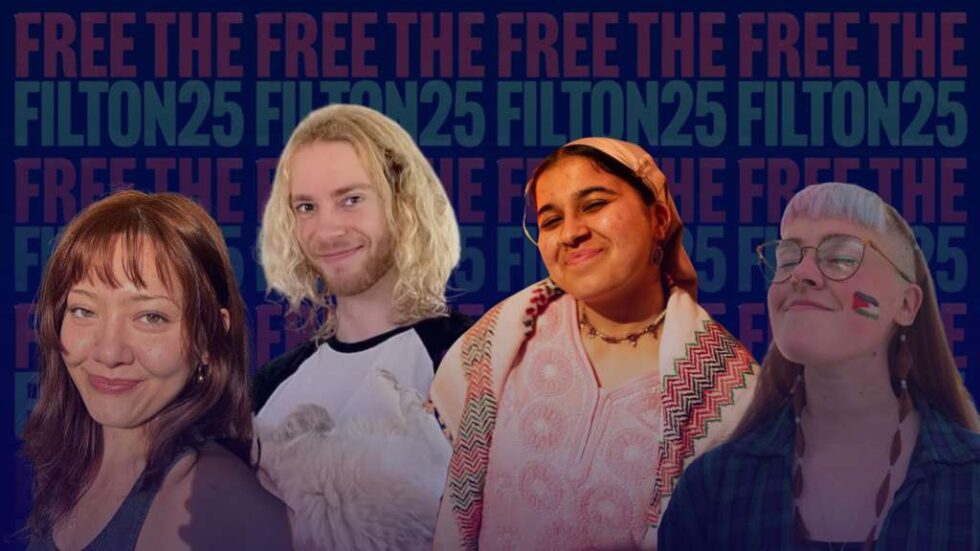


The threat looming over four Palestine Action activists being secretly sentenced as terrorists should not be taken lightly. Such a ruling would not only fundamentally change the sentencing scope for the defendants; it would set a dangerous precedent for how direct action is prosecuted in the UK, marking the first time in British history that direct action is punished through a terrorism framework.
The ongoing case against the Filton25, with the latest addition of co-defendant Lewis Chiaramello, has become a tug of war between the historic right to direct protest and the protection of the establishment status quo, serving as a test for how far UK law will be bent to sustain a foreign state’s arms trade.
How we got here
In August 2024, a small group of six conducted direct action at the Elbit Systems’ research and development hub in Filton near Bristol, where they damaged Israeli quadcopter drones. The six were arrested on site, while the remaining 19 defendants were later arrested on suspicion of playing various roles in the action.
Elbit Systems stands as Israel’s largest arms manufacturer, and played a central role in the genocide of Gaza. The company supplies around 80% of weapons for Israel’s land forces and 85% of combat drones, making it fundamental to sustaining the heavily militarized occupation.
Shortly after the Filton6 were acquitted of charges, a major lobbying campaign ensued demanding a retrial. This came from a range of government figures, journalists, and lobby groups including the Board of Deputies of British Jews, Shadow Home Secretary Chris Philip, and Jewish Chronicle Editor Stephen Pollard, who all publicly applied pressure through both media interventions, and direct political lobbying. In an extraordinary move, the Crown Prosecution Service (CPS) subsequently announced its intention to pursue a retrial without following the proper processes, raising serious concerns about political influence over the case.
Since their arrests, the Filton25 have been treated as suspected terrorists. Homes were raided by counter-terrorism (CT) police and repeated refusals of bail resulted in many of the defendants spending 18 months in prison on remand without trial or conviction, simply for the act of opposing British complicity in genocide.
A timeline of political meddling
This is not an isolated incident, but rather a highlight from a well-established pattern of political interference directly targeting the organization. Palestine Action has faced a long history of coordinated lobbying efforts that ultimately contributed to its proscription in 2025.
In August 2020, just one month after the group’s founding actions against Elbit’s London HQ, then UK foreign Secretary Dominic Raab met with Israel’s Minister of Strategic Affairs Orit Farkash-Hacohen, where he was pressed on protests against Israeli companies in Britain. Raab assured Israeli officials that the UK remains committed to stopping instances of direct action.
In March 2022, then Home Secretary Priti Patel met with Elbit’s UK CEO Martin Fausset to discuss “protests and security.” Briefing notes indicated that one of the main objectives of the meeting was to “reassure Martin Fausset that the criminal protest acts against Elbit Systems UK are taken seriously by the government,” and that Home Office officials were in contact with the police about the organization “to ensure that those who engage in criminal activity progress through the Criminal Justice System.” Similar meetings continued with ministers like Chris Philip.
Over the next few years, FOI documents and reports show repeated Home Office ministerial engagements with Elbit to address the group’s actions, these briefings included CPS involvement. In 2024, Elbit’s UK Security Director Chris Morgan reportedly lobbied the Home Office for a retrial when criminal charges against the group’s co-founders were dismissed.
From June-July 2025, pre and post proscription, the Board of Deputies of British Jews welcomed reports of impending proscription. Jewish Leadership Council issued supportive statements, framing the actions including against Elbit sites as causing fear to Jewish communities. Pro-Israel parliamentary groups like LFI backed the ban in Parliamentary debates and votes.
In February 2026, after the High Court ruled the proscription “disproportionate and unlawful” though pending appeal, the Board of Deputies and Jewish Leadership Council issued a joint statement expressing “deep concern” over the impact on the Jewish community, while welcoming the government’s appeal.
“We’ve used the same tactics as direct action organisations throughout history, including anti-war groups Keir Starmer defended in court, and the government acknowledged in these legal proceedings that this ban was based on property damage, not violence against people.
“Banning Palestine Action was always about appeasing pro-Israel lobby groups and weapons manufacturers, and nothing to do with terrorism … Today’s landmark ruling is a victory for freedom for all, and I urge the government to respect the court’s decision and bring this injustice to an end without further delay.” – Huda Ammori, co-founder of Palestine Action
Together, this record of interference since the organization’s founding speaks to the extent of the insidious, multilayered political manipulation of the UK justice system to defend Israel’s business of war.
The retrial “stitch-up”
During this year’s retrial, four of the six defendants—Samuel Corner, Charlotte Head, Ellie Kamio and Fatema Zainab Rajwani—were convicted of criminal damage. However, Judge Jeremy Johnson withheld from the jury the possibility that the defendants could be sentenced as terrorists under section 69 of the Sentencing Act 2020, which stipulates that a terrorist connection can be attached to certain offences if they meet the definition of the Terrorism Act 2000.
This comes despite the action taking place before the proscription of Palestine Action. Declassified reported that former Home Secretary Yvette Cooper, a Labour Friends of Israel (LFI) member, was warned that proscribing Palestine Action within six months of the hearing could prejudice the activists’ right to a fair trial, yet proceeded regardless. If applied, this would mean that the jury, believing they were only ruling on a criminal damage case, unknowingly convicted the defendants of terrorism.
The terrorism legislation is being applied in two key areas: property damage and political influence. Section 1 of the Terrorism Act 2000 lists types of actions, which includes “serious damage to property,” a clause now being used in relation to the dismantling of Israeli drones and weapons, despite the term itself remaining legally undefined.
The second argument concerns influence: whether the action was intended to influence the government or an international governmental organization. Although the judge accepted that the defendants were not attempting to influence the British government, he argued that a terrorist connection could arise from an attempt to influence the Israeli government by restricting their access to weapons:
“On s1(1)(b) of the TA 2000, Rajiv Menon KC and others strongly argued that influencing government was not the purpose of the action – the purpose of the action was to damage weapons and save lives – I accept that this was one motivating factor – but that does not mean that another purpose was not to damage property to be made available to the Israeli government and thereby influence the Israeli government.” – Judge Jeremy Johnson
The defendants were also reportedly prevented from mounting an adequate defence after being barred from explaining the political context which drove them to act. They were prohibited from explaining their motivations to the jury, what crimes the weapons were being used to facilitate, and the illegality of Israel’s assault on Gaza and beyond.
The argument underpinning direct action is not just moral – it is a legal argument of ‘lawful excuse’ which the defendants should have been entitled to mount under Section 5 of the Criminal Damage Act 1971, but Johnson withdrew that defence. The right to argue that the act was committed to save lives and prevent a greater crime was effectively stripped from the courtroom, and the outcome speaks to the consequences of leaving consciousness at the courthouse door. When political and moral contexts are removed, the act itself is isolated from the conditions that produced it, while jurors are denied their right to judge according to conscience.
Judge Johnson went further than what the prosecution wanted by denying bail for all four defendants. His professional record is notable: Johnson previously represented the police in the Hillsborough and Grenfell cases, as well as the Ministry of Defence, MI5 and MI6 intelligence agencies. He was also selected to rule on Julian Assange’s extradition case. Declassified reported that around 2007, Johnson was appointed by the Attorney General to be a “special advocate.” These are specially vetted barristers who act for the purpose of hearing secret evidence in a closed court. This background, combined with his promotion shortly after retrial, raises serious questions about impartiality in a case of this political magnitude.
The implications of a ‘terrorism connection’
If applied, this would mark the first time in British legal history that direct action is sentenced according to a terrorism framework. From the early acts of civil disobedience by the suffragettes to mass anti-war protests against British involvement in Iraq, Vietnam and now Palestine, direct action has long occupied a central place in struggles for worker rights, democratic reform, environmental activism and anti-war resistance.
The implications of such a decision would extend far beyond the Filton25. It would establish a precedent in which activists can be convicted of one charge under ordinary criminal legislation, only then to be sentenced under an entirely separate terrorism framework carrying vastly different consequences.
Rather than serving 40% of their sentence under the criminal damage charge, the defendants would be required to serve two-thirds of their sentence under a terrorism sentence. Eligibility for early release would require the defendants to completely renounce their political views, making early release highly unlikely. Upon release, they could be classified as terrorists for life.
For up to 10-15 years after release, they would be subjected to extensive monitoring requirements, including registering any new devices, email addresses or relationships with the police or risk re-imprisonment. In practice, this amounts to a semi-permanent regime of political surveillance.
Had they been sentenced solely for criminal damage, many would have already served their time after their 18 months on remand. The addition of the so-called “terrorism connection” transforms every aspect of the sentence, from the time spent in prison to the restrictions applied upon release.
The costs of criminalizing dissent
As it stands, the attempt to attach a terrorism connection to this case points to the political manipulation of the UK justice system in defence of the Israeli war machine. A foreign state’s ability to wage wars of aggression is being protected, while the historic tradition of direct action is being pushed toward criminalization.
If the precedent is set on 12th June at Woolwich Crown Court, it will mark a watershed moment in British legal history, one where opposing war crimes can be treated as terrorism, and the boundaries of lawful protest are redrawn to protect state power rather than democratic dissent.
If you value our journalism…
TMJ News is committed to remaining an independent, reader-funded news platform. A small donation from our valuable readers like you keeps us running so that we can keep our reporting open to all! We’ve launched a fundraising campaign to raise the $10,000 we need to meet our publishing costs this year, and it’d mean the world to us if you’d make a monthly or one-time donation to help. If you value what we publish and agree that our world needs alternative voices like ours in the media, please give what you can today.
Author

Related

The Bane of Empire: Sayyed Hassan Nasrallah’s Legacy Endures
September 27, 2026, marks two years since Israel unleashed over 80 tons of bunker-buster bombs…

Trump’s 600 Days of Broken Promises
At the Republican midterm convention in Dallas on September 10th, President Donald Trump offered voters…

Eight Decades of Occupation: Kashmir’s People Still Deprived of Freedom
Just days ago, India and Pakistan marked 79 years since independence: Pakistan on 14 August…