

Eid Al Mubahila and the Measure of Truth
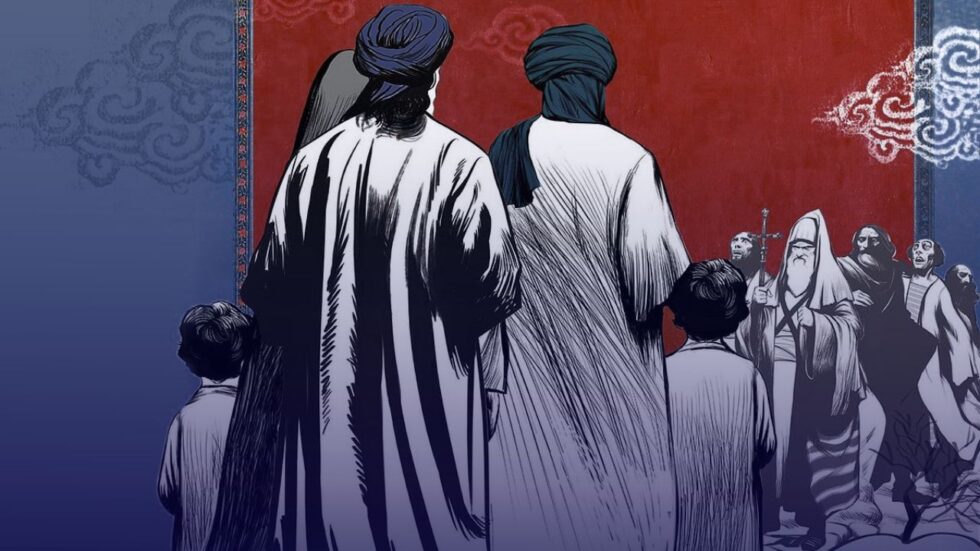


There is a moment in sacred history when numbers lost their meaning.
Eid al-Mubahila commemorates not a battle fought with weapons, but a confrontation of truth stripped to its most intimate core. It commemorates the encounter referenced in Qur’an 3:61, when the Prophet Muhammad met the Christian delegation of Najran following a theological dispute concerning the nature of Jesus. The terms were not set in armies or arguments alone, but in something far more unsettling: to bring your closest, your most beloved, your very selves, and stand before God to invoke His judgment upon the liars.
The Qur’anic verse did not call for spectacle; it called for exposure:
“Come, let us call our sons and your sons, our women and your women, ourselves and yourselves, then let us earnestly pray and invoke God’s curse upon the liars” (Qur’an 3:61).
And in that moment, the Prophet did not gather a multitude. He did not summon tribes or display strength through numbers. Instead, he brought Hasan and Husayn as his sons, Lady Fatima as his women, and Imam Ali as the one identified in the verse as his “self.” This was identification that he made public for all to see. Imam Ali, in this frame, was not merely beside the Prophet, but an extension of him. The household stood as a singular moral body.
Across from them stood a delegation backed by institutional authority, numerical strength, and the weight of empire. Yet when they saw what the Prophet had brought – not soldiers, but sanctity – they hesitated. Tradition tells us that they withdrew from the mutual imprecation, fearing that if such people were to call upon God, even mountains would not withstand the force of that truth.
This is the quiet revolution of Mubahila: it redefines power. It asserts that legitimacy is not derived from numbers, nor from alliances, nor from the machinery of dominance, but from alignment with what is sacred and just. The event is not about triumph in the conventional sense. It is about the unbearable weight of moral certainty when embodied fully.
And this is where the past refuses to remain past.
We live in a time where asymmetry defines nearly every theater of conflict. Vast coalitions, armed with advanced technology and global legitimacy, confront groups that appear, on the surface, marginal – outnumbered, outfunded, and encircled. The language of power today is statistical: military budgets, troop counts, surveillance capabilities. It is the logic of the many against the few.
But Mubahila interrupts that logic.
It asks a different question: who stands with their “selves”? Who is willing to place not just their claims, but their most sacred bonds, on the line for what they assert is true? Because that is what transforms a position into a principle. The Prophet did not bring an army because an army can be assembled; he brought his family because truth, if it is real, must live within the most intimate spaces of one’s life.
In our present moment, this paradigm echoes in unexpected ways. Small, improvised technologies challenge heavily fortified systems. Narratives once controlled by dominant powers are fractured by marginalized decentralized voices. Even in the realm of warfare, the emergence of low-cost technologies that have disrupted long-standing assumptions about military superiority reveals how concentration of resources does not necessarily guarantee decisive advantage.
This is not merely a technological shift. It is a philosophical one. It mirrors the lesson of Mubahila: that scale does not guarantee legitimacy, and that concentration of power does not ensure moral authority. When institutions rely solely on their magnitude, they risk overlooking the force that comes from conviction rooted in something deeper than strategy.
To be clear, Mubahila is not a call to romanticize conflict or to sanctify every form of resistance. It is more demanding than that. It asks whether those who claim righteousness are willing to embody it fully—whether their public stance aligns with their private selves, whether their cause is reflected in the people they hold closest, whether they would stake everything, not just rhetorically but existentially, on the truth they profess.
Because that is the real threshold.
The delegation of Najran did not retreat because they were outnumbered; they retreated because they recognized a kind of certainty that cannot be manufactured. It was not coercion that unsettled them, but coherence – the seamless unity between belief, action, and being.
And that is what continues to unsettle power in every age.
Empires can calculate risk, deploy force, and manage perception. What they struggle to confront is a formation of people who are not merely organized, but aligned, whose sense of purpose is not contingent on immediate victory, but anchored in a longer moral horizon. In such cases, even the smallest presence can carry disproportionate weight, just as a single moment of truth can outweigh volumes of argument.
Eid al-Mubahila, then, is not just a historical commemoration. It is an enduring measure – a measure of sincerity, of courage, of the willingness to stand exposed before God and history alike. It asks, quietly but relentlessly: if you were called to bring your “sons, your women, and yourselves,” what would that reveal about the truth you claim to hold?
Because in the end, it is not the multitude that determines the outcome of such a confrontation. It is the integrity of those who step forward.
If you value our journalism…
TMJ News is committed to remaining an independent, reader-funded news platform. A small donation from our valuable readers like you keeps us running so that we can keep our reporting open to all! We’ve launched a fundraising campaign to raise the $10,000 we need to meet our publishing costs this year, and it’d mean the world to us if you’d make a monthly or one-time donation to help. If you value what we publish and agree that our world needs alternative voices like ours in the media, please give what you can today.
Author

Related
Islamic Unity Week Held in Honor of Holy Prophet Muhammad’s Birth
This past week, nearly two billion Muslims from all over the world celebrated the birth…
How This Year’s Arbaeen Became the Heartbeat of Resistance
Arbaeen marks the 40th day after Ashura, the day Imam Hussain ibn Ali was martyred…
Muharram in the Age of Algorithms: Remembering in a World That Teaches Us to Forget
Muharram begins where the feed ends. Muharram was never about turning suffering into a spectacle. It was, and remains, about refusing to let suffering be swallowed by the machinery of forgetting.