

Eid Al Ghadir: When Leadership Became Testimony


Every age produces power. Not every age produces authority.
Power is abundant. It can be seized, inherited, staged, militarized, televised, mythologized. Authority is rarer. It cannot be manufactured merely by possession. It must be recognized as a moral fact. This distinction is where the modern world, for all its sophistication, remains deeply impoverished. It knows how to count votes, command armies, circulate images, and enforce obedience. But it no longer knows how to ask the oldest and most dangerous political question: what kind of human being is worthy of being followed?
Imam ʿAli says in Nahj al-Balagha, “Governing power is the proving ground for people.” This is the first key to understanding authority. Governing power does not create character; it tests it, exposes it, and makes visible what was already hidden. The ruler who is cruel before becoming ruler will be more cruel after. The ruler who is greedy before power will be more greedy after. Power does not sanctify the soul. It reveals it.
This is why Ghadir matters.
Not simply because it is a disputed event in Muslim memory. Not only because it stands at the heart of Shiʿi self-understanding. But because it stages with unusual clarity the question that every civilization tries to bury beneath institutions and slogans: what is leadership when stripped of costume, intrigue, and force?
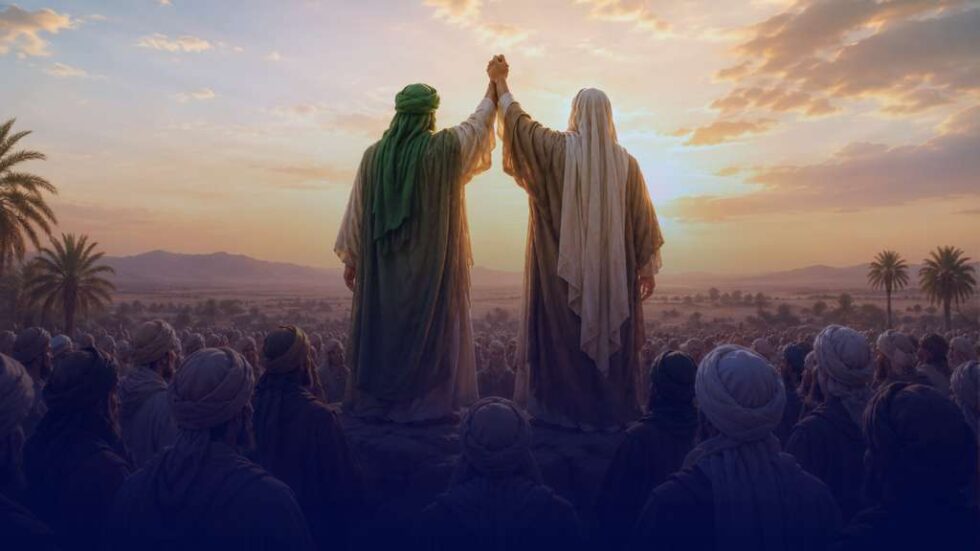
At Ghadir Khumm, in the heat of the Arabian desert, according to Al Thalabi (Sunni Scholar, d. 1035 CE): in his famous Quranic commentary (Tafsir al-Thalabi), he notes that 120,000 people gathered. Sibt ibn al-Jawzi (Sunni Historian, d. 1256 CE): in his historical work Tadhkirat Khasa’is al-Umma, also explicitly records the figure of 120,000 attendees. These were companions who had walked with the Prophet through migration, through war, through the founding of a community that had changed the world. The Prophet called him forward. He called Imam ʿAli. He raised his hand before the entire community, and everyone wondered: what is happening? What is being declared?
Ghadir cannot be reduced to politics. Politics is included, but it is not the whole story. It is a spiritual unveiling whose social and political implications are too deep to separate from the sacred.
The Paradox of Imam Ali: Authority Without Desire
What makes Imam Ali philosophically unique is a paradox rarely seen in history.
The paradox of Imam Ali is that authority seems to seek him more than he seeks authority.
Many rulers claim justice. Many warriors claim courage. Many scholars claim knowledge. Imam Ali’s uniqueness is that he consistently refused to make power an object of desire. He did not court succession. He did not maneuver for office. He did not assemble factions. When he was called forward at Ghadir, he was not the one who had been pursuing the position. The position had been pursuing him all along.
Imam Ali’s significance is deeper than moral superiority. He embodies the idea that legitimate authority emerges from one who is not possessed by the desire to rule.
That is what makes him philosophically singular. In ordinary political life, qualities are fragmented or even contradictory: strength without mercy, intellect without sacrifice, piety without justice, vision without tenderness, ambition without restraint. In Ali, these qualities do not cancel one another out. They are ordered around tawhid, around a God-centeredness that prevents any one human faculty from becoming tyrannical.
The same person who stands at Khandaq also appears in traditions and memory as the man of knowledge, of inwardness, of prayer, of judgment, of charity, of unspectacular care for the vulnerable. This integrity matters. He is not presented to the community as a blank successor awaiting legitimacy from office. He arrives with a life already inscribed by courage, sacrifice, knowledge, and service.
The Battle of the Trench: Faith as the Relativization of Fear
Take the Battle of the Trench. The point of that moment is not simply martial bravery, nor is it reducible to hagiographic spectacle.
Philosophically, it reveals a principle about truth and fear.
When the Muslim community faced Amr ibn ʿAbd al-Wudd, a warrior whose sheer force paralyzed others, the field was divided not simply between two fighters but between two understandings of reality: one in which might terrifies human beings into surrender, and another in which truth so reorders the soul that fear loses its sovereignty. The famous formulation attributed to the Prophet – that the entirety of faith confronted the entirety of unbelief in that duel – has endured because it expresses more than battlefield praise. It names a spiritual anthropology.
Faith here is not inward sentiment. It is the transformation of the self into a being that can stand before overwhelming force without internal collapse.
This is the first key to Imam Ali’s authority: he does not merely wield power, he relativizes it.
But courage alone does not explain Ghadir. If it did, then history would belong to warriors, and Islam would simply ratify another cult of strength.
The Public Witness: Why Revelation Names a Person
Ghadir is not simply a designation. It is the transformation of a community into witnesses.
The truth is disclosed publicly so that history cannot later claim ignorance.
This matters philosophically. Why does revelation publicly identify a person at all? Why is moral authority not left entirely to communal preference? Why is the token of right buried in secret, in private consensus, in the unspoken arrangements of the powerful? Why not let the community decide after the fact, after the silence, after the arrangements of the powerful have already hardened into fact?
The answer is that authority without witness is not authority at all. It is merely hidden power waiting to be discovered.
At Ghadir, the community itself becomes part of the truth. They are not passive observers. They are made responsible. They are asked to pledge allegiance not because allegiance creates legitimacy, but because allegiance acknowledges legitimacy that already exists.
This is why the event is not sectarian in the proper sense. It is not about one group claiming what another group denies. It is about a public disclosure of a standard that any human being, Muslim or non-Muslim, can recognize: the one who has been tested, the one who protects the weak, the one who can stand before power without desiring to imitate it.
The public nature of Ghadir means that no one after can claim ignorance. The witness is built into the structure of the event itself. The desert, the gathering, the raised hand, the declaration- all of it is a testimony that cannot be erased by later history.
This is what makes Ghadir philosophically different from private spiritual experiences. It is not a mystery reserved for the few. It is a public disclosure meant for all of time. The witness is not optional. It is required.
Renunciation as Proof
This is where Imam Ali’s detachment from worldly power becomes philosophically decisive.
He did not accumulate wealth. He did not build palaces. When he was given the choice between the goods of this world and the pleasure of God, he chose God without hesitation. His house was poor. His food was simple. His dress was worn. When he died, he left behind almost nothing.
This is not asceticism for its own sake or withdrawal from the world. This is renunciation as proof.
If authority is to be trusted, it must be demonstrated that the ruler is not ruled by desire.
Imam Ali’s renunciation proves that he is not possessed by the very thing he governs. He is not addicted to power. He is not intoxicated by it. He does not need it to define himself. This is what makes his authority legible. It is not contaminated by the desire for it.
This is the paradox again: the person most worthy of authority is the person least attracted to it for its own sake.
His Governance: Authority as Responsibility
This is not mere abstraction. We can see it in how he governed.
In his letter to Malik al-Ashtar, when he appointed him governor of Egypt, ʿAli wrote:
“Be it known to you, O Malik, that I am sending you as Governor to a country which in the past has experienced both just and unjust rule. Work not against God, for you cannot escape Him. Do not be arrogant, for arrogance is the mark of the insolent. Be gentle with the people, for they are of two kinds: either your brother in faith or your equal in creation.”
This is not a political strategy; it is spiritual substance.
He tells the governor: you are a servant of God before you are a ruler of men. The ruler must first be a servant. Authority is not ownership. It is responsibility.
This letter is the practical embodiment of what Ghadir names. It is the governance that flows from the person who has been spiritually disciplined by truth.
Tawhid Against False Sovereignties: The Revolutionary Implications of Wilayah
Empire approaches the world from above. It counts bodies, territories, markets, and strategic outcomes. It seizes power, holds it, and passes it to those who can hold it most effectively.
The ethic of Ali approaches the world from the wound: from the orphan, the hungry, the humiliated, the one who can be crushed without consequence.
This is not softness. It is a higher and more dangerous conception of strength.
Empire and Ali’s authority are not simply rival political camps. They are rival metaphysics. Empire says: leadership is about power, control, dominance. Ghadir says: leadership is about truth, justice, care for the orphan, courage when no one else stands, and God-centeredness in all things.
In classical Shiʿi thought, especially in figures like Mulla Sadra, Allama Tabatabai, and even modern thinkers like Ali Shariati, wilayah is not simply governance. It is proximity to truth. It is the capacity to orient human beings toward reality.
Imam Ali does not merely deserve authority because of his virtues. He embodies truth because authority itself is participation in truth.
Ali Shariati understood something essential here. He insisted that Islam, and especially Shiʿism, could not be left as a museum of sanctified grief or ritual repetition, because its symbols carried a revolutionary charge against domination, This is what turns Islam into a language of anti-imperial and anti-colonial struggle, not by empty politicization, but by recovering its ethical and historical force.
Shariati’s worldview of tawhid, in which the human being fears only one power and is answerable before only one judge, is profoundly relevant to Ghadir. What is Ghadir, after all, if not the refusal to let society organize itself around false sovereignties? It announces that spiritual truth has social consequences, that a community cannot claim fidelity to revelation while surrendering its moral life to convenience, force, or hierarchy disguised as inevitability.
Tawhid itself is the first rejection of false sovereignty. If there is one God, then no human being can claim ultimate authority. Ghadir is the political embodiment of this theological truth.
This is why Ghadir remains urgent in an imperial age.
Empire always seeks to sever ethics from rule. It wants administration without truth, order without justice, religion without risk, and public life without transcendence. It domesticates faith into private consolation while reserving the sphere of power for calculation, coercion, and spectacle.
Karbala: The Consequence of Betrayal
Karbala also enters here, not as a second topic appended to Ghadir, but as its historical consequence.
If Ghadir names the principle of rightful authority, Karbala reveals what history becomes when that principle is betrayed.
The distance between the two is the distance between truth publicly disclosed and truth politically abandoned. Karbala is not merely a tragedy; it exposes what happens when power succeeds in detaching itself from moral right.
Imam Husayn at Karbala is the same spirit as Imam Ali at the Battle of the Trench: the one who says no when the world demands yes. The one who chooses truth over survival. The one who stands when no one else will.
This is the spiritual lineage:
Ghadir → Imamate → Karbala → the present.
The same refusal to surrender. The same courage when outnumbered. The same God-centeredness when the world demands worship of power.
In that sense, the arc from Ghadir to Karbala is not accidental. It is the drama through which Islam discloses one of its deepest insights: that the corruption of authority does not remain at the level of theory. It eventually drinks blood.
The Question Ghadir Asks
To write about Ghadir today is not merely to revisit an event. It is to reopen the question of what it means to follow truth in a world organized by domination. It is to ask whether communities still recognize the difference between the one who rules and the one who deserves to rule.
Ghadir is not just a memory. It is a question.
Who among us is willing to stand when no one else does?
Who among us carries truth not as possession, but as surrender?
Who among us protects the orphan when the world consumes them?
Who among us says no to empire when the world demands yes?
Who among us is God-centered when the world demands worship of power?
That is what Ghadir names. That is what Imamate means. That is what authority is when it is not contaminated by the desire for it.That is what empire cannot understand. That is why Ghadir endures.
If you value our journalism…
TMJ News is committed to remaining an independent, reader-funded news platform. A small donation from our valuable readers like you keeps us running so that we can keep our reporting open to all! We’ve launched a fundraising campaign to raise the $10,000 we need to meet our publishing costs this year, and it’d mean the world to us if you’d make a monthly or one-time donation to help. If you value what we publish and agree that our world needs alternative voices like ours in the media, please give what you can today.
Author

Related
Islamic Unity Week Held in Honor of Holy Prophet Muhammad’s Birth
This past week, nearly two billion Muslims from all over the world celebrated the birth…
How This Year’s Arbaeen Became the Heartbeat of Resistance
Arbaeen marks the 40th day after Ashura, the day Imam Hussain ibn Ali was martyred…
Muharram in the Age of Algorithms: Remembering in a World That Teaches Us to Forget
Muharram begins where the feed ends. Muharram was never about turning suffering into a spectacle. It was, and remains, about refusing to let suffering be swallowed by the machinery of forgetting.