
From Abraham to Karbala: When Sacrifice Became History


Every year, Eid al-Adha returns with the language of devotion, remembrance, and sacrifice. Yet the danger of ritual is that repetition can make even the most earthshaking truths feel familiar. What was once a trembling confrontation with God can become a custom; what was once surrender can harden into ceremony. The story of Abraham is recited, the animal is slaughtered, meat is distributed, and the moral drama appears complete. But it is not complete. The meaning of sacrifice in Islam does not end at the altar of symbol. It reaches its fullest historical expression in Karbala, where what was once asked as willingness was answered as action.
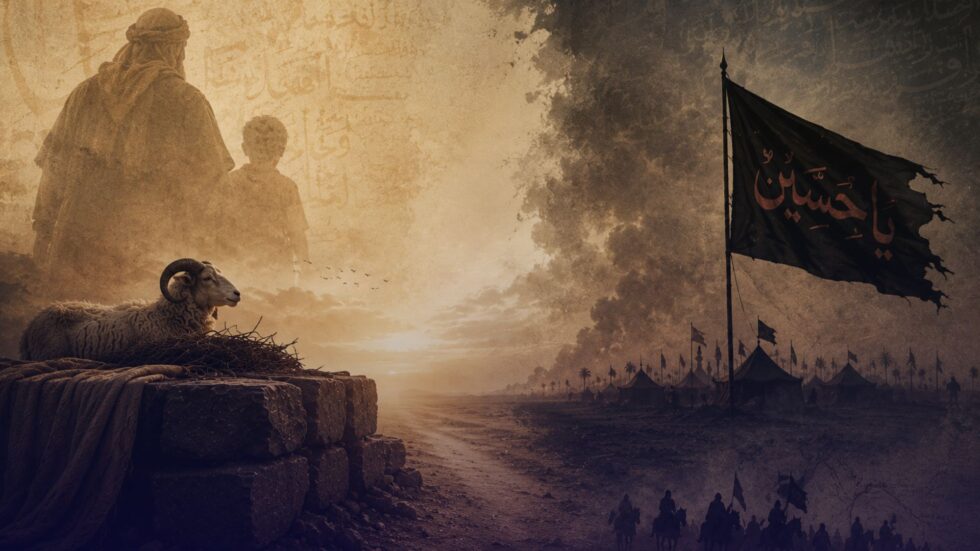
The Qur’anic account of Abraham’s trial is among the most powerful scenes in sacred history. Abraham sees in a dream that he must sacrifice his son, and when he tells the boy, the reply is as astonishing as the command itself: “Do as you are commanded. Allah willing, you will find me steadfast.” The scene is not only about a father’s obedience or a son’s submission. It is about a form of faith that releases its grip on possession, security, and even the future. It teaches that to love God truthfully is to refuse to make an idol of what one loves most. Yet the sacrifice stayed. The knife does not complete its descent. A ram is substituted, and the event enters Muslim memory as the paradigm of surrender and trust.
This matters, because the story of Abraham is often read as though its deepest meaning lies in the fact that the sacrifice did not occur. Mercy, of course, is central. Divine compassion interrupts the blade. But if that is all that is seen, then sacrifice risks being reduced to a private morality of intention: the willingness to give up what is dear, without fully asking what happens when history demands more than inward sincerity. Ibrahim proves willingness. He proves that the believer must be prepared to relinquish everything for the sake of God. But the question remains: what happens when the moral order of the world is so disfigured that sacrifice is no longer symbolic, no longer suspended, no longer contained within ritual memory? What happens when false sovereignty demands not just inward obedience, but outward capitulation?
It is here that Karbala enters not as a separate story, but as the completion of an older one. If Abraham teaches the grammar of sacrifice, Imam Hussain reveals its ultimate syntax. In Karbala, sacrifice is no longer only the private ordeal of the righteous soul. It becomes a public testimony against tyranny. It becomes the refusal to legitimize corruption, even when that refusal carries the cost of death, family, and worldly future. What was latent in Abraham becomes explicit in Hussain. What was preserved in symbol becomes poured into history.
It is perhaps for this reason that Allama Iqbal saw Karbala not as a rupture in the Abrahamic tradition of sacrifice, but as its culmination within history itself. In one of his most profound reflections on Imam Hussain, Iqbal writes in Bal-e-Jibril (Gabriel’s Wing):
غریب و سادہ و رنگیں ہے داستانِ حرم
نہایت اس کی حسین، ابتدا ہے اسماعی
“Strange, yet luminous, is the tale of the Sacred Sanctuary:
Its culmination is Hussain & its beginning is Ismail”
Iqbal writes that “Ismail is the beginning of sacrifice, and Hussain is its culmination.” The insight is staggering because it transforms Karbala from an isolated tragedy into the completion of a sacred ethical trajectory stretching back to Ibrahim himself. In his vision, Karbala reveals what sacrifice ultimately means when confronted not merely with inward trial, but with political tyranny, false sovereignty, and the demand to surrender truth itself.
Iqbal’s vision is powerful because it refuses to separate spirituality from politics, or love of God from resistance to domination. In that vision, Hussain is not merely the inheritor of a legacy of sacrifice; he is the one through whom its latent meaning is unveiled before the world. The blood of Karbala discloses what the trial of Ibrahim had already prepared: that tawhid, if taken seriously, must shatter every claim of absolute worldly power.
That is why Karbala cannot be understood merely as tragedy. Tragedy is too small a word for an event that redefined the ethical meaning of witness. Imam Hussain did not move toward death because suffering is holy in itself, nor because martyrdom is an aesthetic of loss. He moved toward confrontation because there are moments in history when survival purchased through submission is itself a form of spiritual defeat. To give allegiance to illegitimate power would have been to preserve life at the expense of truth. Karbala therefore discloses something terrifying and beautiful at once: that sacrifice in Islam is not simply about renouncing what one loves, but about refusing to surrender moral reality to force.
In this sense, Eid al-Adha and Karbala belong to the same moral universe. Eid remembers the believer who was willing. Karbala remembers the Imam who was required to enact that willingness in the most absolute historical terms. Between them lies a profound ethical movement: from readiness to realization, from interior surrender to embodied witness, from the sacrificial imagination to the sacrificial life. Ibrahim says that nothing can be withheld from God. Hussain shows what that means when the idols are not only in the heart, but in the palace, the army, and the state.
This is also why Karbala has always exceeded the boundaries of mere mourning. Its power lies in the way it transforms grief into judgment. It asks not only whether one weeps for Hussain, but whether one understands why he stood. The answer cannot be confined to emotion. It must become moral clarity. Karbala teaches that there are times when neutrality is complicity, when accommodation is betrayal, and when the defense of truth demands a cost that calculation would never choose. In that way, it rescues sacrifice from sentimentality. It insists that devotion without resistance is incomplete.
This is what makes Eid al-Adha difficult, not merely beautiful. It is easy to honor sacrifice when it remains within ritual form, when it can be commemorated without destabilizing the structures of comfort by which life is ordinarily lived. It is much harder to ask what idols govern the present. Not idols of stone, but idols of appetite, security, nationalism, career, reputation, and fear. Harder still is the question that follows: what if faith requires not only private piety, but refusal? What if sacrifice today means the willingness to lose access, status, belonging, or safety rather than sanctify injustice?
Under such conditions, Abraham and Hussain speak to one another across time. Abraham tells the believer that nothing loved can stand between the servant and God. Hussain tells the believer that this truth is tested most severely when power demands the surrender of conscience. One inaugurates the logic of sacrifice; the other consummates it. One reveals the believer’s readiness before God; the other reveals the believer’s responsibility before history. Read together, they rescue Eid from reduction to custom. They restore it as an education in the soul’s freedom from every lesser claim.
That is why the celebration of Eid al-Adha should not end in the comfort of fulfilled ritual. Its deepest lesson is unfinished unless it produces human beings who can recognize Yazid in every age, not only as a historical figure, but as a principle: the principle that power may demand obedience without truth, allegiance without justice, order without morality. Against that principle, Karbala stands as the final refusal. And in that refusal, the sacrifice of Ibrahim reaches its highest ethical expression.
To say this is not to collapse the distinction between prophet and Imam, nor to erase the uniqueness of each sacred history. It is to recognize a continuity in meaning. The Abrahamic test asks whether one is willing to surrender all for God. Karbala asks whether that surrender can survive the furnace of politics, violence, abandonment, and blood. Eid remembers the first question. History keeps asking the second.
Perhaps this is why sacrifice remains indispensable to the religious imagination: because truth has always demanded more than admiration. It demands detachment from idols, fidelity under pressure, and the courage to stand where comfort ends. Ritual teaches the form. Karbala teaches the cost. And between the two, the Muslim is invited to understand that submission to God is never passive. It is the making of a self that cannot be bought by fear, managed by empire, or reconciled to humiliation.
Eid al-Adha, then, is not only a remembrance of what Ibrahim was willing to do. It is a question directed at every generation: what will be surrendered so that truth may live? Until that question is faced in the shadow of Karbala, sacrifice remains symbolic. With Karbala, it becomes history.
If you value our journalism…
TMJ News is committed to remaining an independent, reader-funded news platform. A small donation from our valuable readers like you keeps us running so that we can keep our reporting open to all! We’ve launched a fundraising campaign to raise the $10,000 we need to meet our publishing costs this year, and it’d mean the world to us if you’d make a monthly or one-time donation to help. If you value what we publish and agree that our world needs alternative voices like ours in the media, please give what you can today.
Author

Related
Islamic Unity Week Held in Honor of Holy Prophet Muhammad’s Birth
This past week, nearly two billion Muslims from all over the world celebrated the birth…
How This Year’s Arbaeen Became the Heartbeat of Resistance
Arbaeen marks the 40th day after Ashura, the day Imam Hussain ibn Ali was martyred…